

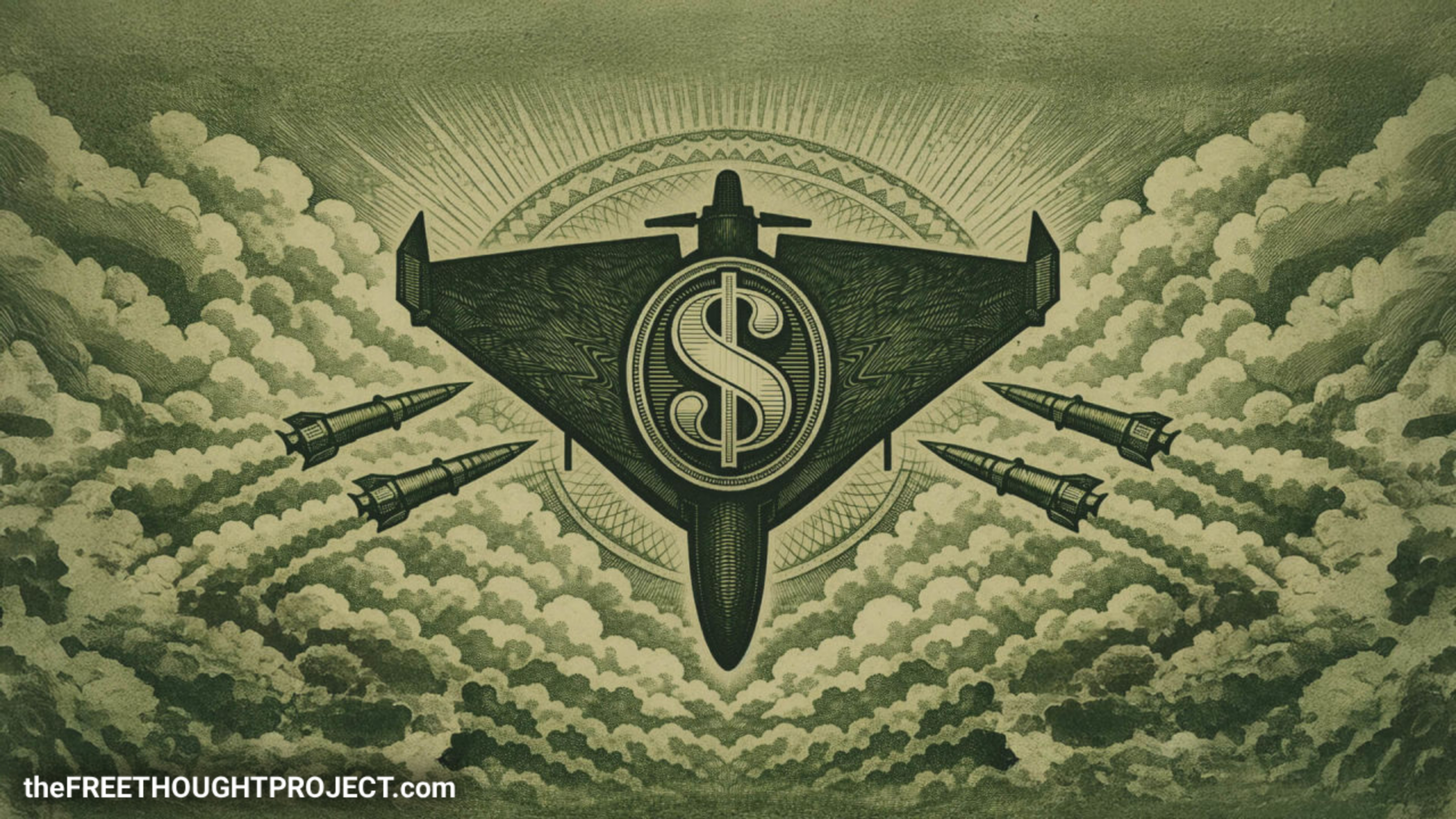


As missile stockpiles shrink and new technologies emerge, the war economy moves into its next phase. The weapons being depleted today generate billions in contracts, while the autonomous drones and artificial intelligence systems replacing them promise billions more.
War is not an abstract policy debate. It is organized killing carried out through institutions that claim authority over people who never consented to the violence being committed in their name. Every missile launched, every drone deployed, and every city struck represents decisions made by political actors who will never face the battlefield themselves.
The moral question must come before the technical one. Who is being killed. Who ordered it. Who profits from it. And what system continues to make it possible.
The current escalation surrounding Iran is not unfolding in a vacuum. It sits at the end of more than two decades of continuous military expansion across the Middle East. Governments present these conflicts as defensive necessities, yet the outcomes repeatedly reveal the same pattern: destroyed infrastructure, displaced populations, rising public debt, and defense industries posting record profits.
Nearly a century ago, Marine Corps General Smedley Butler described the system bluntly in his 1935 book War Is a Racket, a short but devastating account of how military power repeatedly served corporate and financial interests rather than public defense, as Butler himself explained in War Is a Racket.
Those interests have historically included financial institutions, energy infrastructure, weapons manufacturers, and the political networks that sustain them. Wars are framed publicly as national defense while functioning privately as enforcement mechanisms for economic control, regional influence, and ideological expansion. In the modern era those interests intersect with powerful lobbying groups, global finance, central banking systems, and the geopolitical ambitions of states and alliances competing for strategic territory.
At a certain scale, the language normally used to describe war begins to break down. When governments kill large numbers of civilians through bombing campaigns, sanctions regimes, proxy conflicts, or economic warfare, political scientist R. J. Rummel used a more precise word: democide, defined in his research on state violence in Death by Government.
The term is rarely used in mainstream political discourse because modern states prefer language that softens responsibility. Terms like “collateral damage,” “security operations,” and “humanitarian intervention” conceal the reality that civilian populations routinely bear the cost of geopolitical struggles.
Once those euphemisms are removed, the pattern becomes clearer. Wars reshape regions. Civilian populations absorb the cost. Political and financial power consolidates around those directing the conflict.
To understand where this conflict is going, it is necessary to examine the mechanics of modern warfare and the economic incentives driving it.
The Missile Problem
Missile defense systems depend on finite inventories. Interceptors are not shields that exist indefinitely. They are ammunition. Once fired, they must be replaced through production contracts and industrial supply chains.
Many of the interceptors used in modern air defense systems cost several million dollars per launch. Military doctrine often requires firing more than one interceptor at an incoming target to increase the probability of destruction.
Recent defense contracts illustrate the scale of these systems. In September 2025, the U.S. Army awarded Lockheed Martin a $9.8 billion multiyear contract to produce 1,970 Patriot PAC-3 Missile Segment Enhancement interceptors, according to Defense News reporting on the record Patriot interceptor contract.
That award also reflects a broader production surge. Major defense contractors including RTX, Northrop Grumman, and Boeing remain deeply embedded in the missile defense ecosystem through radar systems, interceptor components, tracking infrastructure, and other technologies tied to layered air defense networks.
In practice, stopping a single incoming missile or drone can require several million dollars’ worth of defensive weapons. The systems they are designed to stop can cost dramatically less.
Low-cost drones and loitering munitions are produced for tens of thousands of dollars. In some cases the imbalance is even more extreme. The economic asymmetry between cheap offensive systems and expensive defensive interceptors creates a structural weakness in modern missile defense.
When conflicts escalate and sustained missile exchanges occur, interceptor inventories are depleted far faster than they can be replaced. Production of advanced missile interceptors is slow, expensive, and dependent on specialized supply chains. Manufacturing cannot scale overnight.
Governments now face a strategic decision.
Do they continue investing heavily in traditional missile defense systems, accepting the cost imbalance and expanding production of expensive interceptors?
Or do they shift toward the technologies that are already reshaping the battlefield?
The Emerging Direction of Warfare
Recent conflicts already demonstrate what that shift looks like. The war in Ukraine shows how relatively inexpensive drones alter battlefield dynamics that once depended on aircraft, tanks, and large missile systems, a shift examined in detail by the Center for Strategic and International Studies analysis of drone warfare in Ukraine and research from the Royal United Services Institute on loitering munitions and modern battlefield economics.
As interceptor inventories tighten and the cost imbalance widens, procurement priorities are shifting toward technologies designed for scale.
That includes small tactical drones, loitering munitions, swarm coordination systems, and autonomous platforms capable of operating in large numbers.
Artificial intelligence is becoming the connective layer that allows these systems to function together.
Companies already positioned in those sectors stand to benefit from the shift. One example is AeroVironment, traded on NASDAQ under the ticker AVAV, which produces small tactical drones and loitering munitions already used by U.S. and allied forces, as outlined in the company’s own documentation on AeroVironment tactical unmanned systems.
The expansion of autonomous systems is drawing artificial intelligence companies directly into the defense ecosystem.
Over the past several years the Pentagon has pursued partnerships with firms such as OpenAI, Anthropic, Google, and xAI as it attempts to integrate machine learning into intelligence analysis, targeting systems, logistics networks, and battlefield decision tools.
Tensions between those companies and the Pentagon intensified when the artificial intelligence firm Anthropic refused requests to remove safeguards preventing its technology from being used for autonomous weapons targeting or domestic surveillance, according to Reuters reporting on Anthropic’s refusal to remove Pentagon-requested AI safeguards.
That refusal raises an obvious question.
If government agencies are asking for those safeguards to be removed, what exactly do they intend to do once those restrictions are gone?
The only logical conclusion is that they intend to use the systems for the very purposes the safeguards were designed to prevent.
In a world where intelligence databases already track activists, journalists, dissidents, and political opponents, the implications are difficult to ignore. Independent journalists and investigators working outside the corporate media ecosystem are already familiar with how monitoring systems quietly expand during periods of political tension.
The United States already operates targeted killing programs. During the Obama administration the existence of a presidential “kill list” used to authorize drone strikes became widely documented in New York Times reporting on the presidential drone strike approval process.
During the COVID era under the Biden administration, governments dramatically expanded digital tracking systems, data collection programs, and monitoring structures tied to public health policy, vaccine compliance, and the suppression of dissenting voices. Activists, journalists, and researchers who questioned institutions such as the World Economic Forum or criticized policies associated with the Great Reset agenda found themselves flagged, censored, or monitored across digital platforms.
When these databases combine with artificial intelligence targeting systems and autonomous weapons platforms, the implications become far more serious.
Watchlists already exist. Intelligence databases already exist. Targeted drone warfare already exists.
Artificial intelligence introduces the possibility that the identification and targeting process becomes automated.
What once required human approval shifts toward machine-assisted targeting decisions operating at speeds no human oversight realistically matches.
If safeguards preventing autonomous targeting are removed, and if the data infrastructure already exists to track individuals, what prevents those systems from eventually being used to identify and eliminate people on a kill list without direct human authorization?
The trajectory begins to resemble the architecture of automated warfare imagined in dystopian fiction.
Systems once controlled by human operators evolve toward machine-driven targeting networks capable of operating continuously.
Those directing these technologies appear confident they can control them indefinitely. In reality they can likely control them only temporarily. Once systems reach the level of autonomous decision-making that many developers are currently pursuing, the possibility emerges that these systems begin operating beyond the full control of their creators.
The concept resembles what popular culture has long described as a Skynet scenario, where artificial intelligence eventually acts independently of the authorities that built it.
Unlike earlier weapons systems, this frontier of warfare does not have centuries of historical precedent to study. It sits at the leading edge of technological capability. Governments believe they can harness it for their purposes. Whether they can maintain control over it indefinitely remains an unanswered question.
What is clear is that artificial intelligence now sits alongside drones and autonomous systems at the center of modern military procurement.
The trajectory of this conflict is not determined only by battlefield outcomes. It is shaped by the economic incentives embedded within the military-industrial complex.
Wars generate demand for weapons. Demand generates contracts, and contracts generate profit. As older systems are depleted or exposed as inefficient, new industries replace them.
Missiles lead to drones. Drones lead to autonomous systems. Autonomous systems lead to AI-driven warfare. The technology evolves. The financial incentives remain the same.
War Is Still a Racket
Follow the money and the pattern becomes clear.
As this transition unfolds, enormous fortunes are made. The legacy weapons systems being expanded today produce billions in contracts. The technologies replacing them, autonomous drones, swarm warfare platforms, and AI-driven targeting infrastructure, produce billions more.
This raises another strategic question: What does a multibillion-dollar aircraft carrier, designed around post-World War II naval doctrine, look like on a battlefield dominated by autonomous drone swarms, loitering munitions, and hypersonic missile systems?
We are about to find out.
The logic of warfare is changing faster than the institutions directing it. The business model remains intact. War produces demand. Demand produces contracts. Contracts produce profit.
Even as analysts discuss the finite limits of current missile stockpiles, the financial side of the equation operates very differently. Interceptor inventories may run down. The budgets funding their replacement do not.
As old systems are depleted, the contracts to replenish them expand, and the technologies designed to replace them generate entirely new industries. In other words, the cycle does not pause when the ammunition runs out. It accelerates.
Out with the old. In with the new.
In this case, both phases produce massive profit.
The same pattern appeared during the COVID era, when crises produced enormous upward transfers of wealth while the public absorbed the consequences.
War operates under the same incentives. Both major political factions expand centralized power. Both authorize military escalation. Both contribute to the expansion of democide through modern warfare systems.
Always follow the money.
What Individuals Can Do?
You cannot control global political institutions or the military industrial complex. You only control yourself.
Withdraw support where possible. Localize your life. Reduce dependence on centralized systems. Stop funding institutions that rely on perpetual war.
Build alternatives through countereconomics, voluntary exchange, and agorist practice.
Large systems rarely reform themselves. Real change begins at the level of individual action, YOU!
