

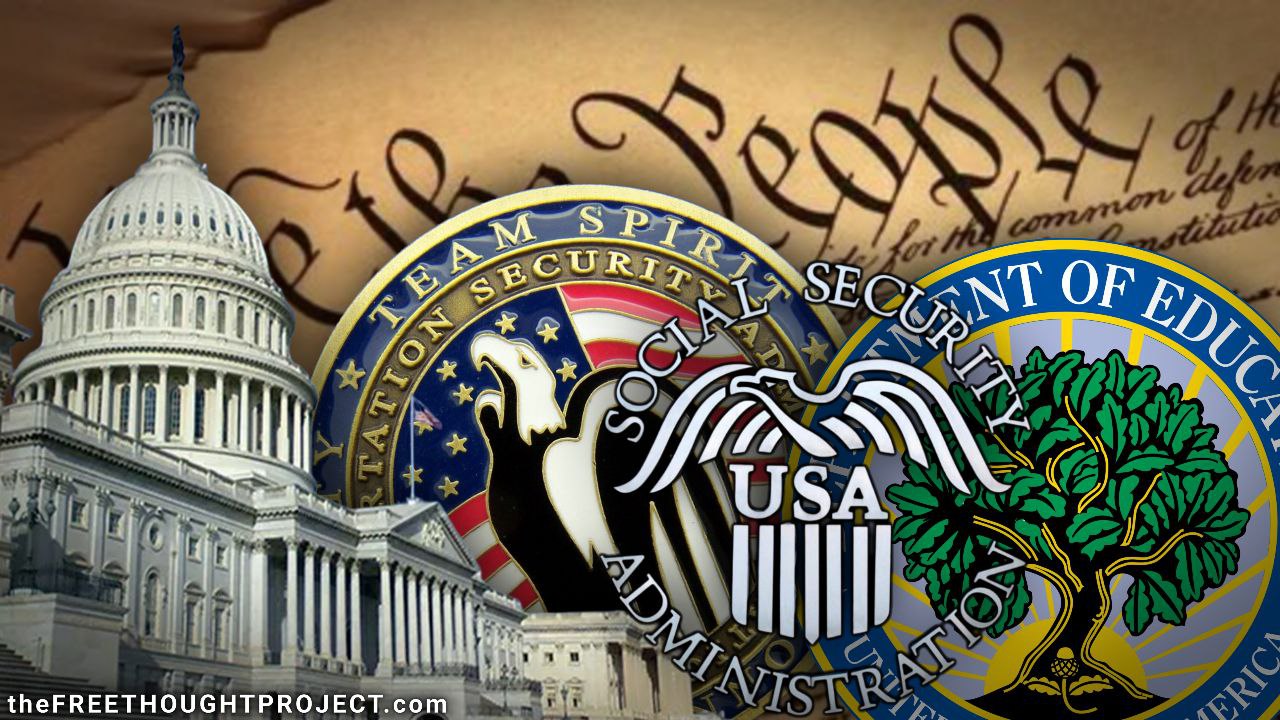


The Constitution of the United States has strict parameters over what power the federal government does - and does not - have. Despite this, federal power has grown to overreach their limitations substantially, defying areas of civic life that should be regulated by voluntary free exchange, not government dictate.
(Future of Freedom Foundation) The Act of Supremacy of 1534 declared that King Henry VIII (and his successors) was “the only supreme head in earth of the Church of England” and not the pope of Rome. The Treason Act of 1534 made it an act of treason, under punishment of death, to deny the Act of Supremacy. During the reign of Queen Mary, the daughter of Henry VIII, the Act of Supremacy was repealed, but was enacted by the English Parliament again in 1559 after Henry’s other daughter Elizabeth became the queen. The British monarch is to this very day still the head of the Church of England or Anglican Church, which is the established church in England. This is one of the main differences between the United States and Great Britain. Although the United States has a National Cathedral where some state funerals are held (most recently for Jimmy Carter), it is actually an Episcopal church (part of the worldwide Anglican Communion), not owned or controlled by the federal government. The “separation of church and state” is a hallmark of the American system of government.
The First Amendment
The Constitution was drafted in 1787, ratified in 1788, and took effect in 1789. It established the United States as a federal system of government where the states, through the Constitution, granted a limited number of powers to a central government. The Bill of Rights (the first 10 amendments to the Constitution) was ratified by the states in 1791 in response to criticisms of the Constitution by the Anti-Federalists that the Constitution contained no explicit protection of speech, assembly, religion, or the right to bear arms.
The First Amendment reads: “Congress shall make no law respecting an establishment of religion, or prohibiting the free exercise thereof; or abridging the freedom of speech, or of the press; or the right of the people peaceably to assemble, and to petition the government for a redress of grievances.” It was President Thomas Jefferson who, in an 1802 letter to the Baptists of Danbury, Connecticut, equated the religion clauses in the First Amendment with the “separation of church and state”:
Believing with you that religion is a matter which lies solely between Man & his God, that he owes account to none other for his faith or his worship, that the legitimate powers of government reach actions only, & not opinions, I contemplate with sovereign reverence that act of the whole American people which declared that their legislature should “make no law respecting an establishment of religion, or prohibiting the free exercise thereof,” thus building a wall of separation between Church & State.
That the “separation of church and state” applied to just the federal government is evident by the fact that some of the states still maintained established churches at the time the Constitution was adopted. The phrase was resurrected by Justice Hugo Black in the case of Everson v. Board of Education (1947). But as Mike Maharrey of the Tenth Amendment Center has observed: “The federal government’s use of the First Amendment to prohibit religious displays in local parks, to force the removal of the Ten Commandments from public schools, or to ban prayers in public assemblies would horrify the founding generation.” Massachusetts was the last of the original states to fully disestablish its churches in 1833. The idea of the “separation of church and state” is now enshrined in all state constitutions.
But religion is not the only thing that should be separated from the state. Unfortunately, the very people who talk the loudest about the separation of church and state never call for the separation of anything else from the state.
The issues
Education needs to be separated from the state. Although the federal government has a Department of Education, it does not own and operate schools, employ teachers, or educate a single child. What it does do — aside from employing a lot of bureaucrats — is provide some of the funding of public schools, issue grants and loans to college students, and regulate education on every level. Yet, the Constitution is silent on the subject of education. There is nothing in it that authorizes the federal government to be involved in any way, shape, or form with the education of anyone. This means that there should be no grants, loans, mandates, requirements, standards, initiatives, or regulations. And of course, no Department of Education. Every state has provisions in its constitution for the operation of K-12 schools, colleges, and universities. But this doesn’t mean that the states should do so. Education is a service that can be provided on the free market just like hair styling, auto repair, and pest control.
Charity needs to be separated from the state. There are about 80 means-tested welfare programs in the United States that provide cash, food, housing, utility subsidies, medical care, and social services to poor, disabled, and lower-income Americans on the basis of the beneficiary’s income or assets. But the federal government has no money of its own. Every dollar it hands out must first be taken from productive Americans. There are three problems with government welfare programs: (1) It is immoral to take money from some Americans and transfer it to other Americans — even if the government is doing the taking; (2) The Constitution does not authorize the federal government to institute welfare programs or give the states block grants to operate welfare programs; (3) It is not a legitimate purpose of government to fund or operate welfare programs, fight poverty, subsidize anyone’s wages, help the disabled, establish a safety net, provide job training, or aid “the poor.” Neither is it the purpose of government to force us to be charitable or compel us to be virtuous. All government welfare programs should be eliminated, and all charity should be individual, private, and voluntary. And the same goes for foreign charity: foreign aid and disaster relief. The U.S. government gives over $50 billion a year — in one form or another — to over 170 countries and more when there is a flood, typhoon, or earthquake. Any American who wants to help another country with disaster relief, economic development, feeding the hungry, or defense should reach into his own pocket.
Retirement needs to be separated from the state. Although no American has to sign up for Social Security when he reaches retirement age, every American is forced to pay Social Security taxes throughout his entire working life. The program is funded by a 12.4 percent payroll tax (split equally between employers and employees) on the first $176,100 of employee income. Self-employed persons pay the full amount of the tax. But since when is it the job of government to have a retirement, disability, or savings plan for anyone but government employees? Because benefits are calculated by an arbitrary formula with no connection between Social Security taxes paid and benefits received, the program is simply welfare for seniors, just as Temporary Assistance for Needy Families (TANF) is welfare for the poor, Special Supplemental Nutrition Program for Women, Infants, and Children (WIC) is welfare for new mothers, and Supplemental Security Income (SSI) is welfare for the disabled. All retirement programs should be private and voluntary.
Medicine needs to be separated from the state. After Social Security, Medicare and Medicaid are the two largest programs in the federal budget. Medicare is government-funded health care for Americans 65 and older and for those under 65 who are permanently disabled. Medicare Part A (hospital insurance) is funded by a 2.9 percent payroll tax (split equally between employers and employees) on every dollar of employee income. Medicaid is government-funded health care for eligible low-income adults, children, pregnant women, elderly adults, and people with certain disabilities. Medicaid is jointly financed by the federal and state governments, but designed and administered by state governments within federal guidelines.
In addition, the federal government heavily regulates medicine even though the Constitution says nothing about physicians, medications, health care, health clinics, medical procedures, medical insurance, medical research, diseases, pandemics, epidemics, medical treatments, hospitals, medical devices, medical licensing, medical laboratories, or medical schools. Health care is a service that can and should be provided on the free market just like education. No American is entitled to health care provided at the expense of another American — regardless of how poor, old, sick, or disabled he is. No American should be forced to pay for the health care or health insurance of any other American.
Alcohol needs to be separated from the state. On the federal level, numerous rules and regulations apply to distilling spirits, and an excise tax must be paid. There are 17 states in America in which the state government has a wholesale and/or retail monopoly over some or all types of alcoholic beverages, especially distilled spirits. In some cases, the state government owns and operates the liquor stores, and private stores are strictly prohibited. Some states still have “dry” counties, cities, or towns where no alcohol can be sold. In every state, no alcohol of any kind can be sold without a license. It is not the proper function of government to regulate what beverages Americans wish to consume. Alcohol should not be treated any differently from any other commodity when it comes to production, licensing, sales, or consumption.
Drugs need to be separated from the state. The federal government classifies marijuana as a Schedule I controlled substance under the Controlled Substances Act (CSA) with “a high potential for abuse,” “no currently accepted medical use,” and “a lack of accepted safety for use of the drug under medical supervision.” Possessing, growing, transporting, or distributing marijuana is a federal felony, with violations resulting in fines and/or imprisonment. Although it is true that the medical use of marijuana is legal in 39 states and the recreational use of marijuana in 24 states, there are so many state and local government rules and regulations that the marijuana market is far from free. And this is just marijuana. Getting caught with cocaine, meth, or heroin by federal or state agents will send you to jail, directly to jail, without passing Go or anything else.
The war on drugs is a war on personal freedom, private property, limited government, personal responsibility, individual liberty, personal and financial privacy, civil liberties, the free market, and freedom itself. If a man owns his own body, then it follows that he should be able to consume any substance he chooses in whatever quantity he chooses — even substances that are unhealthy, harmful, dangerous, addictive, and destructive. All drug laws should be repealed, and all government agencies devoted to fighting the war on drugs should be abolished. There should be a free market in drugs just like the market for fruits and vegetables.
Trade needs to be separated from the state. Although it is true that countries and governments don’t trade, that is, engage in international commerce, and that only people and businesses do, the federal government heavily regulates trade, negotiates trade treaties and agreements, calculates trade deficits and surpluses, and imposes protective tariffs on many imported goods. But international commerce does not need to be regulated by the government any more than domestic commerce. Managed trade is not free trade. All trade treaties and agreements should be withdrawn from, all tariffs should be eliminated, the Office of the U.S. Trade Representative should be abolished, and the Export-Import Bank should be closed. Free trade means that trade is conducted without being hindered by government tariffs, quotas, barriers, regulations, restrictions, or dumping rules.
Economists need to be separated from the state. Most economists in the United States are employed by federal, state, and local governments or the central bank. The Federal Reserve Board employs more than 400 Ph.D. economists. But as the Austrian economist Ludwig von Mises (1881–1973) pointed out shortly after World War II, “The development of a profession of economists is an offshoot of interventionism. The professional economist is the specialist who is instrumental in designing various measures of government interference with business. He is an expert in the field of economic legislation, which today invariably aims at hindering the operation of the unhampered market economy.” Economists justify this as necessary to combat “market failure,” the theory of which, in the words of modern Austrian economist Joseph Salerno, is “a rhetorical device used to conceal the fact that modern welfare economics is based squarely on the Santa Claus principle that the state is an entity existing apart from society and possessing mysterious powers to tap into a fount of resources that it can freely shower on selected individuals and groups without imposing deprivation on other individuals and groups.” Prior to World War I, economists were generally viewed unfavorably by the state because they exposed the state for the predatory organization that it is. But nowadays, as explained by libertarian theorist Doug Casey: “Most economists are political apologists masquerading as economists. They prescribe the way they would like the world to work and tailor theories to help politicians demonstrate the virtue and necessity of their quest for power.” No economist in the employ of the state can be trusted.
Security needs to be separated from the state. In some countries, there is only one airline, and it is state-owned and operated. In other countries, the government is just a major shareholder. Such has never been the case in the United States. Yet, even though all of the airlines are private in the United States, airline security is not. The Transportation Security Administration (TSA) was created two months after the 9/11 attacks as part of the Aviation and Transportation Security Act. The act gave the federal government sole and direct responsibility for airline security, including secret TSA rules for putting individuals on a terrorist database, a no-fly list, and a selectee list, which triggers “enhanced screening” of certain passengers at the airport. But as investigative journalist James Bovard — a frequent TSA critic — has said: “TSA protocols make flying vexing without making travelers safe,” “more than 500 TSA agents have been fired for robbing passengers,” and “TSA screeners failed to detect 95 percent of the test bombs and weapons during covert tests by federal inspectors.” But not only does the TSA do a poor job, it does an unnecessary job. There is no reason why airports and airlines cannot provide their own security. And not only that, what is the government doing providing security for private businesses? The federal government has no more authority to provide airport security than it has to provide security at hotels and convenience stores.
Sex needs to be separated from the state. There used to be laws against adultery, fornication, homosexuality, and cohabitation in almost every state. Laws against these things that are still on the books of some states are typically not enforced. Occasionally, a state will repeal one. But this does not mean that sex is separate from the state. Every state still has laws against prostitution — and they are surprisingly more stringent than similar laws in most European and South American countries. But why is paying someone directly for sex considered a crime, but paying someone indirectly for sex with dinner and a movie is not considered a crime? And why is it legal for someone to provide free sexual services to as many people as desired, and as often as desired, but illegal for someone to charge for sexual services? All laws against prostitution and all regulation of “gentlemen’s clubs” and “escort services” should be eliminated.
Conclusion
Everything that can be provided by the free market should be separated from the state. Not just the obvious things like education, medicine, and retirement, but also things like art, space exploration, and sports. Art existed just fine before the National Endowment for the Arts (NEA). There are private spaceflight companies, and there would be more if it weren’t for the existence of the National Aeronautics and Space Administration (NASA). And why do states have boxing and athletic commissions?
In a truly free society, government — in whatever form it exists — would be strictly limited to reasonable defense, a judicial system, and policing activities. As Doug Casey has explained, “Since government is institutionalized coercion — a very dangerous thing — it should do nothing but protect people in its bailiwick from physical coercion. What does that imply? It implies a police force to protect you from coercion within its boundaries, an army to protect you from coercion from outsiders, and a court system to allow you to adjudicate disputes without resorting to coercion.”
