

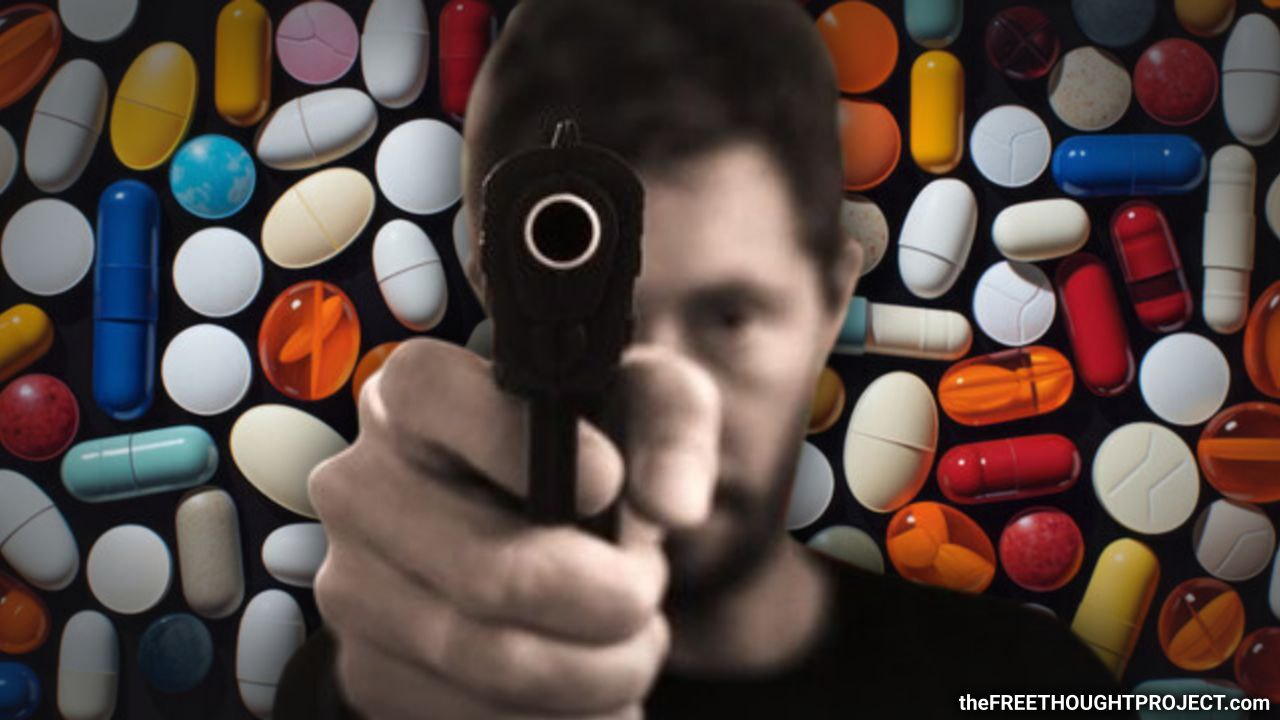


With nearly every mass shooting one common denominator is frequently overlooked, and it's the one that pharmaceutical companies make billions of dollars off of.
Nine dead, twenty five wounded, several families devastated, and a country in mourning. That is the result after 18 year old Jesse Van Rootselaar murdered her mother and stepbrother, and proceeded to carry out a mass shooting at Canada's Tumbler Ridge Secondary School in rural British Columbia.
And as fury erupts online with the same old talking points, the public is ensnared in the same tired debates while ghoulish grifters do everything they can to exploit the tragedy to promote their own culture war narratives. Right wing charlatans like Infowars focus on the shooter being transgender, attempting to falsely equate trans identity with a higher propensity for violence despite the fact that data from The Violence Prevention Project at Hamline University identifies that transgender people make up for only 0.11% of mass shootings. While on the left side of the false paradigm they predictably renew their anti gun rhetoric attempting to blame the firearm for the shooting despite Canada's stringent anti gun laws.
All the while the real glaring issue is buried under the noise. It seems to be self evident that much of the West is suffering from a mental health crisis of epic proportions. And it didn't get this way by accident.
Obviously said mental health crisis is a subject of great nuance and multifaceted. To simplify it one could say that it is largely, though not entirely, due to demoralization. The public is consistently subjected to any manner of things that negatively impact their mental well being; financial hardships brought about by the deliberate corporate exploitation of the working class and the devaluation of fiat currency, the mental strain of living under a totalitarian police state, or the constant deluge of media saturated with negative messaging and subconscious programming focusing on stress, anxiety, fear, sadness, anger, etcetera. But another causal factor is the way in which the public is deliberately poisoned.
Poor physical health directly leads to declining mental health. And the physical health of the masses is far from great. The water is loaded with microplastics. The air is full of pollutants. The food full of chemicals. All the while pharmaceutical mega corporations want to shove pills down our throat for any and everything.
Therein lies the rub, a multibillion dollar pharmaceutical industry that profits from perpetual illness. A financial conflict of interest that prioritizes exploiting the sick, or even creating them, to maximize monetary gain.
Perhaps nowhere is this more apparent than in the psychiatric cartel.
Over the last few decades the growing pharmaceutical industry has made it so that prescription pills became the go to option for physical and mental ailments. An analysis of data which The Free Thought Project has previously reported on has shown the various ways in which the industry incentivizes the mass prescribing of antidepressants, through the manipulation of clinical trial results, the influence of academic research and the suppression of risk assessments. As well as a lucrative relationship in which over half (55.7%) of active U.S. psychiatrists receive payments from drug manufacturers.
It goes without saying that big pharma has woven a web of corruption and drug dependency, with dependency on antidepressants being one of their most lucrative markets.
As TFTP reported a decade ago, a landmark study conducted by the Nordic Cochrane Centre at the University of Copenhagen authored by Professor Peter Gøtzsche found that antidepressants, specifically Selective Serotonin Reuptake Inhibitors (SSRI's), result in individuals being twice as likely to consider violence and suicide.
SSRIs dominate the prescription drug market, with several notable medications including Aventyl (nortriptyline), Celexa (citalopram hydrobromide), Lexapro (escitalopram oxalate), Norpramin (desipramine HCl), Paxil (paroxetine HCl), Prozac (fluoxetine HCl), Seroquel (quetiapine), Wellbutrin (bupropion HCl), Zoloft (sertraline HCl), and many others.
In 2018 we reported findings that pharmaceutical giants including Eli Lilly and GlaxoSmithKline paid hundreds of millions of dollars in secret settlements between the 1980s and 2010 due to their SSRI antidepressants being credibly linked to instances of murder or suicide.
Furthermore, a 2022 study in which researchers looked at 17.5 million adults in the United States who have been diagnosed with depression over 10 years, with around half on medication and half not, found that overall antidepressants didn't offer any measurable increase to well-being and health-related quality of life. In layman's terms, they didn't make people any happier.
As recently as 2025 a reanalysis of a notable 2004 study, Treatment for Adolescents with Depression Study (TADS), which played a significant role in shaping how doctors prescribed antidepressants, specifically Prozac, to adolescents found the original study results were deeply flawed. The reanalysis found that researchers had originally hidden the extent of adverse effects including suicidal thoughts or actions, misled findings, and manipulated data to achieve the desired results while the effects of the medication showed no real benefits.
Considering how influential the TADS study was in the early 2000s at fostering prescription policy towards kids and teenagers these findings are no less than groundbreaking when considering the irreparable harm it likely caused.
Bringing us to the matter at hand, while predatory pundits seek to exploit mass shootings to perpetuate their own agenda they often overlook this glaring common denominator found in so many high profile shootings.
John DeCamp, lawyer for the victims of the 1999 Columbine massacre, has been steadfast in his assertion that psychotropic drugs including Zoloft played a direct role in influencing the actions of Eric Harris and Dylan Klebold.
Following the infamous "Batman shooting" at an Aurora, Colorado movie theater in 2012, it was discovered the perpetrator James Holmes had been on a combination of antidepressants (Sertraline, a generic version of Zoloft) and a drug known to potentially induce hypnosis (Clonazepam, a benzodiazepine).
Reports show that the Charleston church shooter Dylann Roof was under the influence of SSRI's just prior to the 2015 massacre at a black church which sparked fury across the nation.
Following the 2016 shooting at an Orlando nightclub, federal investigators suppressed information which indicated the shooter Omar Mateen had abruptly developed an obsession with psychotropic drugs, although it was unknown if he was taking any at the time of the shooting.
The Baton Rouge shooter Gavin Long, an honorably discharged Marine Corps veteran, was on multiple prescribed medications for PTSD prior to engaging in a mass shooting with Louisiana police.
Following the infamous Mandalay Bay hotel shooting in 2017, The Free Thought Project conducted an exclusive interview with Dr. Peter R. Breggin, a Harvard trained psychiatrist and leading expert in the field of anti-depressant induced mass murders, author of the book Medication Madness: The role of Psychiatric drugs in cases of Violence, Suicide, and Murder, who discussed the likelihood that psychiatric drugs played a role in the shooting that left sixty people dead.
Similarly, 19 year old Nikolas Cruz was revealed to have been on antidepressants before engaging in a shooting spree at Florida's Parkland High School that left 17 dead in 2018.
As was David Katz, who killed two and injured ten that same year, as well as Ian David Long who murdered twelve.
And Dayton mass shooter Connor Betts who killed nine in 2019.
And infamous Covenant school killer Audrey Hale in 2024...
We could go on. In fact, the website SSRIStories.net does just that, meticulously documenting hundreds of instances connecting SSRI medication with acts of violence for at least two decades.
Of course none of this should allude to a case of correlation being causation. As mentioned earlier the mental health crisis and subsequent tragedies that stem from it are a nuanced and multifaceted issue. This is also not meant to demonize anyone who legitimately does require medication to stabilize their mental health. I myself am one of those people and my own experience goes to demonstrate the complex nature of the subject.
From a young age I struggled with mental health as a result of growing up in a dysfunctional and abusive environment, being diagnosed with both depression and anxiety disorders at the tender age of ten years old, yet rather than addressing the obvious root cause of my childhood trauma a psychiatrist determined that all that was needed was a chemical cocktail to fix me. One of the numerous medications I was prescribed was Zoloft, and the result? Throughout my early teen years I attempted to take my life three times, until at the age of 14 I refused to take any more medication for my own well-being.
That does not mean my mental health struggles went away. Throughout most of my life into adulthood I dealt with debilitating depression and anxiety including frequent suicidal ideation. Still, I fought against it, unmedicated, completely set against psychiatric medication due to my previous experience. But as I got older it got harder, until March of 2025 I suffered several days long debilitating panic attacks seemingly out of nowhere with no apparent trigger that resulted in my admission to the hospital out of fear of a heart attack.
After the doctors ran several tests on me to ensure my heart was indeed healthy it was determined the attacks were brought on due to the immense strain of the several years of untreated mental health issues. After a lengthy discussion with my doctor, who is knowledgeable of the potential risks of these medications and sympathetic to my past experiences, we ultimately came to the mutual decision for me to try a prescription for Lexapro, also an SSRI, to mitigate the symptoms.
Now sitting here a year later at 31 years old I can say it was one of the best decisions I ever made. The effects were almost immediate, and to date I'm happier, less angry, more energetic. I actually feel like myself again and am happy to be alive. A completely night and day difference between my experience with Zoloft and other medications as a teenager.
So yes, this subject is complex. What works for some can have no effect or disastrous effects on others. Yet while it is wise to be wary of correlation-causation thinking, such drugs consistently being linked to acts of violence cannot be ignored and must be thoroughly investigated.
We should also keep in mind that there is no one size fits all approach to public health. Each person is different, with a diverse set of experiences and unique needs. If we've learned anything it's that scrutiny needs to be placed on those who stand to benefit. Either the corporations that continue to profit from tragedy, or the government institutions with a history of exploiting the mentally ill to manufacture terrorist plots.
There can be no simple answer to complicated issues. And we won't get anywhere until people get comfortable with asking uncomfortable questions.
