

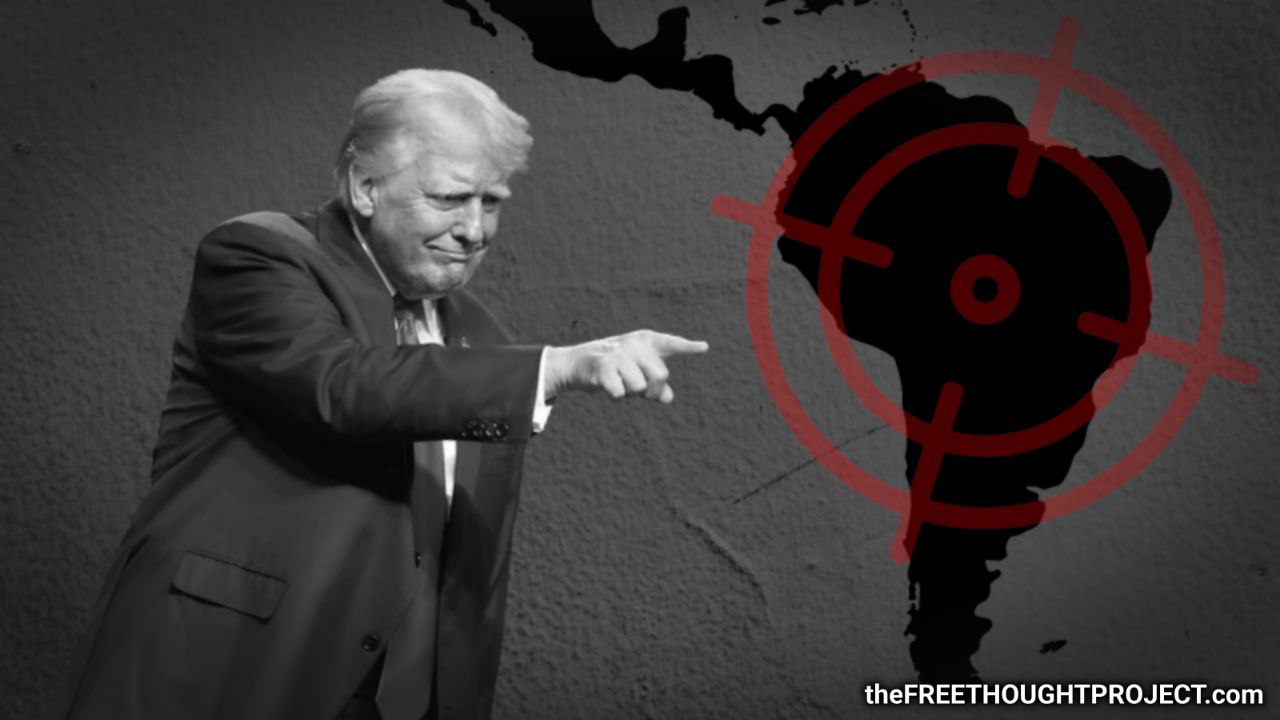


Ever since the establishment of the Monroe Doctrine the United states has asserted itself as the sole authority in the Western Hemisphere. Acting on these imperialist ambitions it has carried out over a century of intervention in Latin America, overthrowing governments and destroying lives in the process.
Another year, another coup. Sadly we at The Free Thought Project accurately predicted the toppling of Venezuela's government some months ago. In our article titled From Iraq To Venezuela: Different Invasions Using The Same Playbook, we highlighted the various ways in which the American Empire was essentially reusing the very same rhetoric that was utilized to justify various regime changes of the past two decades, particularly in Iraq, but also drawing parallels to Libya and Syria.
We outlined some of the recent history of US aggression against Venezuela, stating thusly:
As far back as 2002, the United States attempted a regime-change coup against then-President Hugo Chávez under the administration of George W. Bush.
In recent years, there have been numerous attempts to overthrow the Maduro government, including during Trump’s previous term, when his administration launched a series of assassination attempts against President Nicolás Maduro and fully backed the rise of extremist coup leader Juan Guaidó. In 2020, Venezuela foiled several attacks, including a CIA-linked terror plot and an attempted Bay of Pigs–style invasion—code-named Operation Gideon—which resulted in the capture of two U.S. Green Berets.
Even more recently, analysis has revealed that last year’s wave of unrest following the re-election of Nicolás Maduro— unjustly contested by the U.S. and its allies following staunch US-backed election interference —was orchestrated by a network of U.S.-backed agitators. This was followed by another foiled coup attempt in which 14 mercenaries, including a U.S. Navy SEAL, were captured along with a cache of weapons.
If history is any indicator, US hostilities against Venezuela will not stop anytime soon, and if they do it will likely be in the aftermath of yet another disastrous regime change war.
Will Venezuela suffer the same fate as Iraq and so many others? Only time will tell.
Unfortunately, this question was answered last week when in the middle of the night explosions rang out throughout Venezuela's capital of Caracas, killing one hundred innocent people, followed by a contingent of U.S. special forces invading the sovereign nation and descending upon the home of president Nicolas Maduro, kidnapping him along with his wife and flying them back to the United States to stand trial under indictment for bogus narco-terrorism charges that the Justice Department has already begun to walk back.
Now, in the midst of Trump's flagrantly unconstitutional act of belligerence and blatant violation of international law, the quagmire that is likely to follow in Venezuela is yet but another corpse to throw in the unmarked grave of the victims of neoliberal colonialist expansionism that the United States of America's unique brand of Monroe Doctrine era imperialism has reaped upon Latin America.
Previously, we republished a commentary detailing some of the history of US intervention in Latin America, highlighting the coups in Cuba, Guatemala, and Chile and the ways in which they destabilized the region. Now, in light of these recent developments, we will provide some further historical context by recounting some of the various victims of American interference throughout Latin America.
Rather than providing a comprehensive account of US meddling in the region, we shall recount several of the more significant episodes of interventionism. A complete chronological list of US intervention throughout Latin America including direct involvement and military occupations up to 2005 can be read here via Harvard University.
The history of the United States' neocolonialist ambitions in Latin America began with a significant policy shift in the 19th century under the Monroe Doctrine, when in 1823 president James Monroe gave an address to Congress framed as opposing European recolonization in the Americas while in reality expressing the US's expansionist ambitions with the intent of bringing the entire Western Hemisphere under the sphere of American influence and dominance. A doctrine that has been a staple of US foreign policy for the last 200 years.
In the latter half of the 1820s, the United States began extending the doctrine diplomatically, sending liaisons to nations such as Chile, Argentina, and Mexico to establish formal relations. However, barely 20 years after its establishment, the imperialist ambitions of the doctrine were put on display for all the world to see, first with the outset of the Texas Revolution of 1835, followed by the fraudulent Mexican-American war in 1846, which stole half of Mexico's territory working congruently with the expansionist ideology of Manifest Destiny, heavily rooted in settler colonialism and white supremacy.
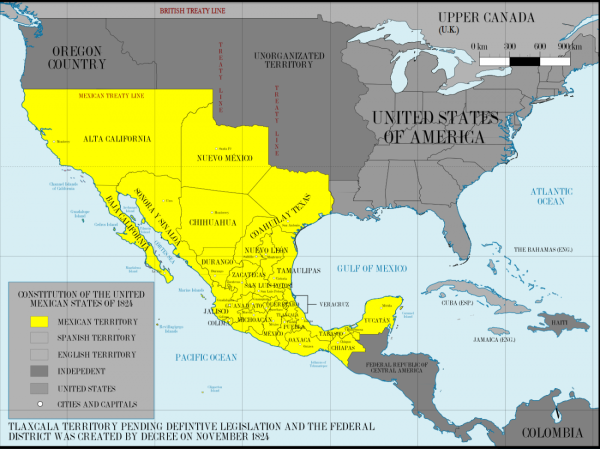 HistoryColorado.org">Map of Mexico prior to 1835. Source: HistoryColorado.org
In 1913 amid the Mexican Revolution, during which swarms of peasant laborers rose up against the ruling class dictatorship of Porfirio Diaz in favor of the more popular Francisco Madero, the United States through the involvement of ambassador Henry Lane Wilson tacitly backed the betrayal and overthrow of Madero by the forces of General Victoriano Huerta in what became known as the ten tragic days (“La Decena Trágica”). In order to secure US business interests in the country, ambassador Lane would facilitate the coordination of rebel leaders via the US embassy resulting in a military coup d'etat that is one of the most violent in Mexico's history, culminating with the ousting and assassination of President Madero and the return of Mexico to authoritarian rule under a military junta.
Beginning in the Summer of 1933, Cuba began to experience political upheaval as protests and general strikes grew across the nation in disapproval of the increasingly authoritarian tactics of president turned dictator Gerardo Machado, which included brutal acts of state terror and repression against dissidents. Capitalizing on the unrest, the US saw an opportunity to insert itself into the fray to gain control over Cuban politics and thus began supporting rebellion. Following the ouster of Machado, the US via Ambassador Sumner Welles put its full support behind the rise of military dictator Fulgencio Batista. Who would establish a brutal regime of his own, serving as the dominant political and military force in Cuba until the revolution of 1954 led by Fidel Castro.
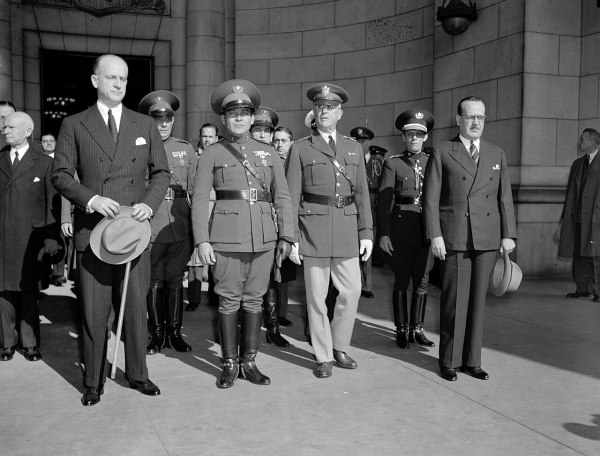 Fulgencio Batista, Chief of Staff of the United States Army General Malin Craig, Ambassador from Cuba Dr. Pedro Fraga. Source: Wikimedia Commons.">Fulgencio Batista in Washington DC, November 10, 1938. Left to right: Undersecretary of State Sumner Welles, Fulgencio Batista, Chief of Staff of the United States Army General Malin Craig, Ambassador from Cuba Dr. Pedro Fraga. Source: Wikimedia Commons.
At the same time Cuba was liberating itself from imperial powers, Guatemala was falling victim to it. Between the years of 1944 and 1954 Guatemala experienced a period of growth and prosperity that came to be known as the "Ten Years of Spring" following the 1944 revolution that ousted authoritarian dictator Jorge Ubico, infamous for exploiting Guatemala's natural resources and selling them out to multinational corporations. Over the next decade reformist leaders Juan José Arévalo, and Jacobo Árbenz championed policies of labor rights and redistributed large swaths of unused land previously claimed by US corporations such as United Fruit Company. By 1954 The US government had enough of Guatemala's prosperity interfering with the profits of their business interests. That year the CIA would orchestrate a coup under the name Operation PBSUCCESS, creating a militant rebel force and, through the use of psychological warfare and bombing campaigns, would overthrow Árbenz and install a military dictatorship under Castillo Armas.
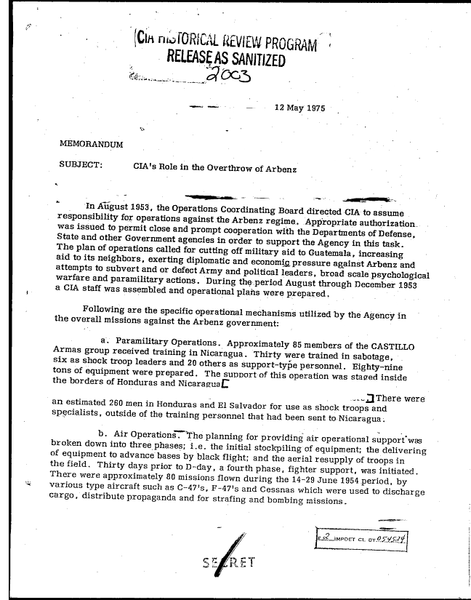 CIA.gov">Memo describing the CIA's organization of the paramilitary deposition of President Jacobo Árbenz. Declassified 2003. Source: CIA.gov
As the Cold War mounted several more Latin nations were placed on the imperial chopping block throughout the 1960's, including Honduras, the Dominican Republic, Bolivia, Brazil, and others. By the 1970's the regime change machine was in full swing. Perhaps one of the most vile examples of American backed regime change in the region came in Chile on September 11th, 1973. Even prior to the 1970 election the CIA had desired to do away with Salvador Allende to maintain US dominance in the region. For three years the Nixon administration in Henry Kissinger plotted to depose Allende, lending tacit support to neo fascist paramilitary elements under the control of general Augusto Pinochet.
During Pinochet's reign in Chile, a series of several other coups in central Latin America would install fascist military dictatorships in the countries of Argentina, Bolivia, Brazil, Paraguay, and Uruguay, that would then consolidate together with the help of US intelligence to launch Operation Condor: a bloody campaign of state terror throughout South America who's roaming death squads would target anyone the regime's considered to be dissident, resulting in the rampant kidnapping, torture, rape, and murder of over 80,000 people, with an additional 400,000 political prisoners disappeared throughout the 1970s and 80s.
Throughout the 1980's the US would embroil itself in the conflicts in El Salvador and Nicaragua. In El Salvador, rather than toppling a government the US was supporting one, after the repressive regime of the military junta came to power in a coup in 1979. Guerrilla forces backed by the US such as the Atlácatl Battalion carried out numerous atrocities during the conflict, such as the infamous El Mozote Massacre in which the US backed forces summerly executed upwards of 1000 El Salvadorian civilians, including over 500 children.
Meanwhile in Nicaragua the US was busy supporting Contra rebels in their fight to overthrow the Sandinista government, in an affair that led to the infamous Iran Contra scandal, and operations by the CIA supporting cartel drug trafficking to fund US activities in the region.
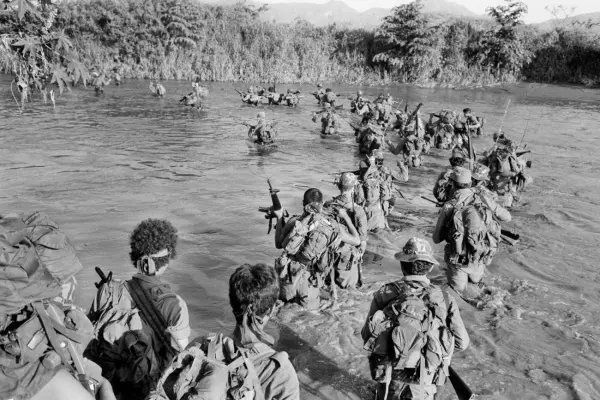 Robert Nickelsberg/Getty Images">Salvadoran members of the Atlacatl battalion cross a river during a military operation in San Miguel department, El Salvador, sometime in late August or early September 1983. Robert Nickelsberg/Getty Images
Right at the tail end of the decade, in December 1989, the United States launched one of its most blatant overthrows in the region with Operation Just Cause and the invasion of Panama. Despite dictator Manuel Noriega's previous status as an asset for the Central Intelligence Agency, the US once again felt the need to exercise its dominance in the region in the wake of the erratic behavior of the drug kingpin they helped bring to power. And so on December 20th 1989 over 20,000 U.S. Marines invaded Panama resulting in a swift overnight coup that set a precedent for later interventions in the years to come.
Though 1990s saw a notable reduction in regime change efforts in the region as the cold war would come to an end and US foreign policy would shift to the middle east, by the early 2000s attention began to shift back to the region, marked by the aforementioned 2002 attempted coup against Hugo Chavez in Venezuela, the 2004 coup and continued destabilization in Haiti, the 2009 coup in Honduras, and later efforts to exercise anti democratic influence on Brazil to depose president Dilma Rousseff and install the far right US backed puppet Jair Bolsonaro.
In the years since, US meddling in Latin America certainly hasn't stopped. By the latter half of the decade the US regime change machine was back in action taking aim at numerous Latin nations. 2019 would see the US overthrow the government of Evo Morales in Bolivia with a bloodless coup supported by intelligence agency cutouts, and two years later do the same thing in Ecuador with the help of a subversive color revolution network, making it clear that regional dominance in South America is back at the forefront of US foreign policy.
With president Donald Trump expressing his intent to "run Venezuela for years", it is left up to the imagination what kind of protracted quagmire will result from the de facto occupation.
