

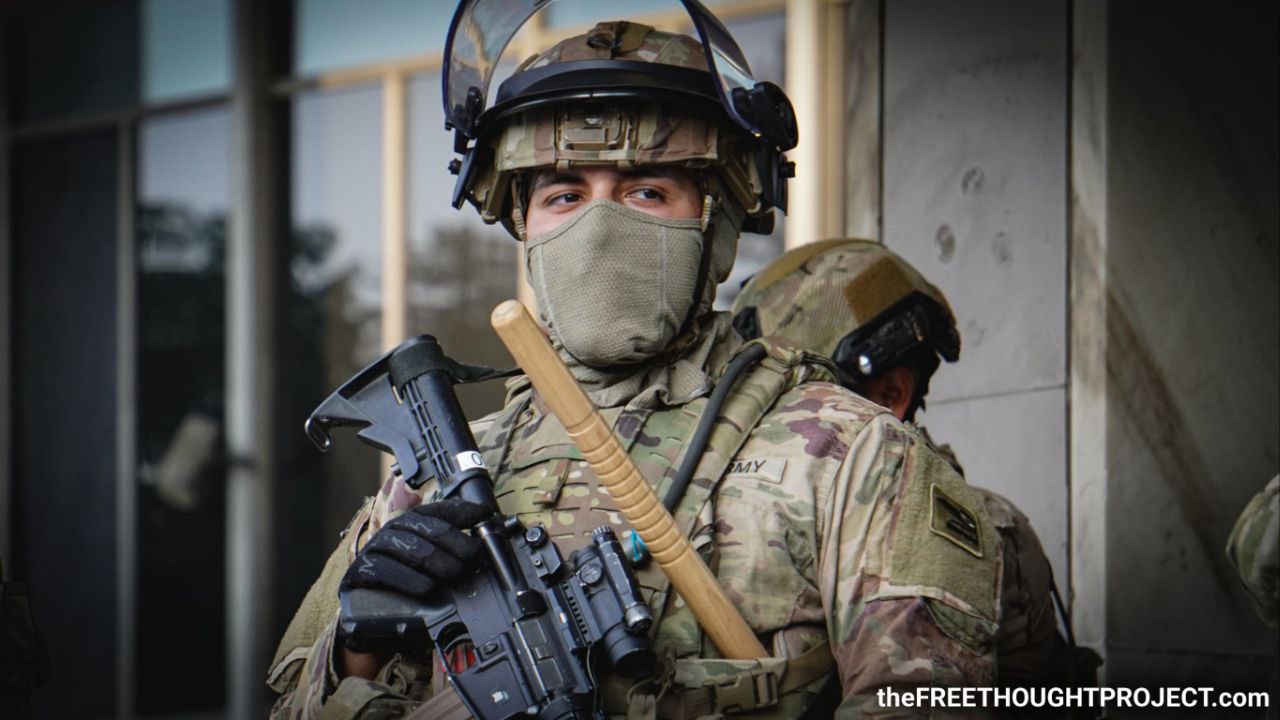


How Minnesota’s National Guard mobilization fits into the escalation of federal power and law enforcement authority.
Like many people right now, we at The Free Thought Project have been watching events unfold and asking the same questions: What happens next as federal force escalates? What can realistically be done about it? Can state or local authorities intervene in any meaningful way? What actually follows in the scenarios people keep talking about, not in theory but in the real world?
We are writing this to walk through those questions plainly. We are going to lay out what the National Guard mobilization in Minnesota actually enables, how the official language fits into the legal command structure governing the Guard, and what outcomes follow if state or local authorities attempt to oppose federal action. This is about structure, sequence, and consequence, and how those elements interact once certain steps are taken.
The official explanation is straightforward. Minnesota Governor Tim Walz says the National Guard has been mobilized to support public safety, “help keep the peace, ensure public safety, and allow for peaceful demonstrations,” in the wording used by the governor’s office and repeated publicly in the January 8, 2026 press release. That release states the Guard was authorized “out of an abundance of caution and in coordination with local officials” and ordered to be staged and ready to support local and state law enforcement following unrest after the killing of Renee Nicole Good, a Minnesota resident shot by a U.S. Immigration and Customs Enforcement agent in south Minneapolis. Cellphone footage captured by bystanders and additional video taken from the vantage point of the ICE agent’s own phone, and obtained and synchronized by news organizations, shows the encounter unfolding in the street as the ICE agent fired at Good’s vehicle near the intersection of Portland Avenue and East 34th Street during the federal enforcement operation (see New York Times video).
According to multiple sources, Renee Nicole Good was shot and killed by an Immigration and Customs Enforcement (ICE) agent during a federal immigration enforcement operation in Minneapolis on January 7, 2026. Good, a 37-year-old U.S. citizen, was in her vehicle when ICE agents approached; footage captured by bystanders and obtained by news outlets shows the encounter unfolding in the street as she attempted to move her vehicle. In the moments that followed, the ICE agent fired multiple shots at her vehicle, striking Good and causing fatal injuries, including at least three gunshot wounds. Federal officials initially described the shooting as justified on self-defense grounds and said the agent was treated for injuries, while local leaders and eyewitnesses disputed that narrative and pointed to the civilian-recorded videos as the central evidence of the encounter’s dynamics. Good’s death sparked immediate protests and heightened tensions around the expanded federal enforcement presence in the city.
Executive Order 26-01, issued with that announcement, authorizes the National Guard to protect critical infrastructure and assist local law enforcement with additional tasks as requested, placing Guard personnel, equipment, and facilities on state active duty. The order frames the Guard in a support role, focused on safeguarding property, protecting infrastructure, and allowing local law enforcement to remain focused on community safety and investigative responsibilities. The Minnesota State Patrol simultaneously mobilized additional units to support law enforcement operations in the Twin Cities.
Although the order states that Guard involvement should occur only after local law enforcement resources are exhausted, that language functions as sequencing rather than restraint. It delays escalation but imposes no meaningful limit on authority, mission scope, or ultimate control. It governs when force is added, not what that force ultimately serves once deployed.
That framing has been consistent across state communications. The Guard is not described as deployed into the streets. It is described as prepared. The emphasis is on order, readiness, and response if unrest escalates, using the same “staged and ready to support local law enforcement if needed” language found in the governor’s own headline.
This is the narrative circulating publicly.
Public interpretation has diverged. Some assume the Guard is being positioned to protect demonstrators from federal action. Others view the mobilization as reinforcement for law enforcement authority. The official language clarifies the stated purpose.
The Guard is being mobilized to support law enforcement.
That phrase carries legal meaning. It does not include language about restraining federal agencies. It does not describe a buffer between civilians and federal officers. It does not distinguish between state and federal enforcement. U.S. Immigration and Customs Enforcement is a federal law enforcement agency within the Department of Homeland Security, as defined in DHS materials. When the stated mission is support for law enforcement and maintenance of order, the alignment follows directly from the wording itself.
This contrast becomes more pronounced when viewed alongside the governor’s later remarks. On January 14, 2026, Walz delivered a separate public address responding to what he described as the federal government’s ongoing presence in Minnesota, condemning ICE operations as indiscriminate, violent, and unlawful, and describing masked federal agents detaining people without warning, breaking windows, dragging individuals into unmarked vehicles, and conducting what he characterized as kidnappings rather than lawful arrests (January 14, 2026 remarks).
In that address, Walz urged Minnesotans to protest peacefully, to film ICE activity, and to create records for future accountability. He framed federal operations as an occupation and a campaign of brutality. Notably, those remarks did not announce any change to Executive Order 26-01, the Guard’s written mission, or its posture. The Guard remains defined, in writing, as a support force for law enforcement and infrastructure protection, not as an intervening force against federal operations.
At that point, “protection of life and property” becomes the operative question: whose life and whose property?
From the perspective of people opposing federal enforcement actions, the answer is concrete. Federal agents are law enforcement. Federal buildings are federal property. The mission as articulated protects enforcement operations and the infrastructure supporting them. It does not articulate protection for civilians against federal action.
There is only one way state or local authorities could actually stop federal abuse, unlawful detentions, or killings: open interposition. That would require state agencies and local departments to refuse cooperation and physically block federal operations. This is not a regulatory disagreement or a jurisdictional dispute. It is an escalation into direct conflict between governments.
At that point, the issue is no longer protest management or public safety. It becomes open conflict between governments.
No language in the mobilization suggests preparation for that outcome. No governor is positioning local officers, Guard units, or state agencies for direct confrontation with federal forces. The Guard is not being positioned as an independent defensive force acting on behalf of civilians. It is being positioned as an auxiliary force aligned with enforcement authority.
Once that is understood, what happens next is procedural, not hypothetical.
The National Guard operates under a dual command system. Under ordinary conditions, Guard units answer to the governor. That authority is conditional. Federal law allows the President to federalize a state’s Guard at any time. When federalized, command transfers immediately and state authority ends under 10 U.S.C. § 12406, with Guard members thereafter serving in federal status as governed by 10 U.S.C. § 12407 and the Insurrection Act authorities contained in 10 U.S.C. Chapter 13.
The Congressional Research Service describes these authorities as mechanisms for enforcing federal law when state or local actions obstruct it.
At the same time, federal officials have publicly floated expansive immunity claims. Vice President J.D. Vance asserted that ICE agents have “absolute immunity,” a statement legal experts and fact checks say is false as a matter of law but revealing in intent (10News; Lawfare; Al Jazeera). The effect of that messaging is immediate. It signals to agents that force will be defended, and to the public that accountability will be resisted.
That deterrence has already shown itself in practice. Two days after Good’s killing, video circulated of an ICE agent confronting a woman filming federal officers and saying, “Have y’all not learned from the past couple of days?” before seizing her phone, according to her account. The exchange was reported by People. Whatever disputes arise later about legal interpretations, the message on the street was clear: what happened to Good was being used as a warning.
A federal judge later issued an order limiting ICE’s ability to detain or retaliate against peaceful observers and protesters in Minnesota, acknowledging evidence of reprisals against people for filming or following federal agents (Reuters; FOX 9). That order exists precisely because ordinary enforcement language had already collapsed into intimidation, as reflected in the record of the preliminary injunction issued by the U.S. District Court for the District of Minnesota in Tincher et al. v. Noem et al., Doc. 85 (Jan. 16, 2026).
Once the Guard is mobilized, federal takeover becomes administratively simple. Troops are activated. Logistics are in place. The situation is framed as a security matter. Federal authority assumes control of an existing force rather than assembling a new one.
This is where the mobilization becomes analytically significant.
By mobilizing the Guard under the stated purpose of public safety and law enforcement support, the state places a force in a posture that serves federal escalation rather than limiting it. If protests intensify, if federal officials assert obstruction, or if the executive branch determines escalation is warranted, the Guard can be federalized without delay.
Even if the governor personally condemns ICE operations, the command structure prevents that opposition from being operationalized through the Guard. When state orders conflict with federal priorities, state command ceases and federal command applies.
This reflects the design of the system.
Author’s Thoughts:
From the standpoint of people who reject coercion and do not consent to rule by distant authorities, this mobilization is not ambiguous. It does not exist to protect the public. It exists to preserve the machinery acting upon it.
By staging the National Guard in advance, Governor Walz is mobilizing force in a way that removes friction for federal escalation. An already activated Guard allows federal authority to assume control of an existing force rather than deploy one from scratch. That sequencing matters. It lets federal takeover be framed as a reaction to disorder instead of the opening move, and it lets Walz posture as if he tried to stop federal abuse, even while the structure guarantees he is handing over the keys.
Many people believe the Tenth Amendment provides states with a real defense in moments like this. It does not. The Tenth Amendment states that powers not delegated to the federal government, nor prohibited to the states, are reserved to the states or the people. That reservation exists on paper. It is not an enforcement mechanism. It does not authorize states to physically block federal action. It does not nullify federal statutes. It does not prevent federal courts from asserting supremacy. It does not restrain federal forces once deployed.
In practice, the Tenth Amendment allows states to decline cooperation, withhold funding, and refuse administrative assistance. The moment that refusal becomes physical interference, federal authority asserts itself through supremacy doctrine, statutory enforcement powers, and force. There is no clause in the amendment that permits states to defend civilians from federal action through armed resistance while remaining inside the Union.
For a state to go beyond noncooperation and attempt to stop federal enforcement by force would require more than invoking the Tenth Amendment. It would require severing its relationship to the federal system itself. That path is not procedural or symbolic. It is existential. It is secession. It is the opening of a civil war.
We cannot stress this enough and want to make this clear. If state and local departments, agencies, or officials attempted to use their own forces to stop ICE or other federal units outright, refusing cooperation, physically blocking federal operations, or trying to defend civilians from federal enforcement, that action would not be lawful resistance within the system. It would represent the first open steps of a new civil war between governments. At that point, the conflict is no longer rhetorical, judicial, or electoral. It becomes kinetic.
At that moment, the National Guard would not be on the people’s side. Again, once federalized, the Guard exists to suppress state resistance, not support it. That is not a hypothetical. It is a built-in function of the central federal system.
This structure did not arise accidentally. Early American resistance succeeded because it relied on decentralized militias loyal to their communities rather than to a central authority. That model defeated the British Crown. It also threatened centralized power. Over time, militias were absorbed, standardized, and reorganized into the National Guard system so federal command could override state and local loyalty.
The National Guard is not a continuation of the colonial militia tradition. It is its containment. It exists to prevent the type of organized resistance that once removed a distant tyrant.
This reflects the design of the central system, not state powers reserved by the Tenth Amendment. The amendment does not save states from this outcome. It does not empower them to defend their populations while remaining within the federal structure.
As long as a state remains inside that structure, it cannot physically defend its population from federal enforcement without triggering federal takeover and internal conflict. Courts arrive later. Elections arrive later. The force arrives first.
The fraud is believing the system still contains an internal safety valve for tyranny. It does not. The National Guard will not act for the people against federal power. It will be used by those who command the system, including those who operate through proxies and figureheads, regardless of which names occupy the offices.
This is why the federalization and restructuring of the National Guard away from genuine community militias, specifically to ensure it can be absorbed into federal command, fails the moment the federal government itself becomes the tyrant that must be resisted.
