

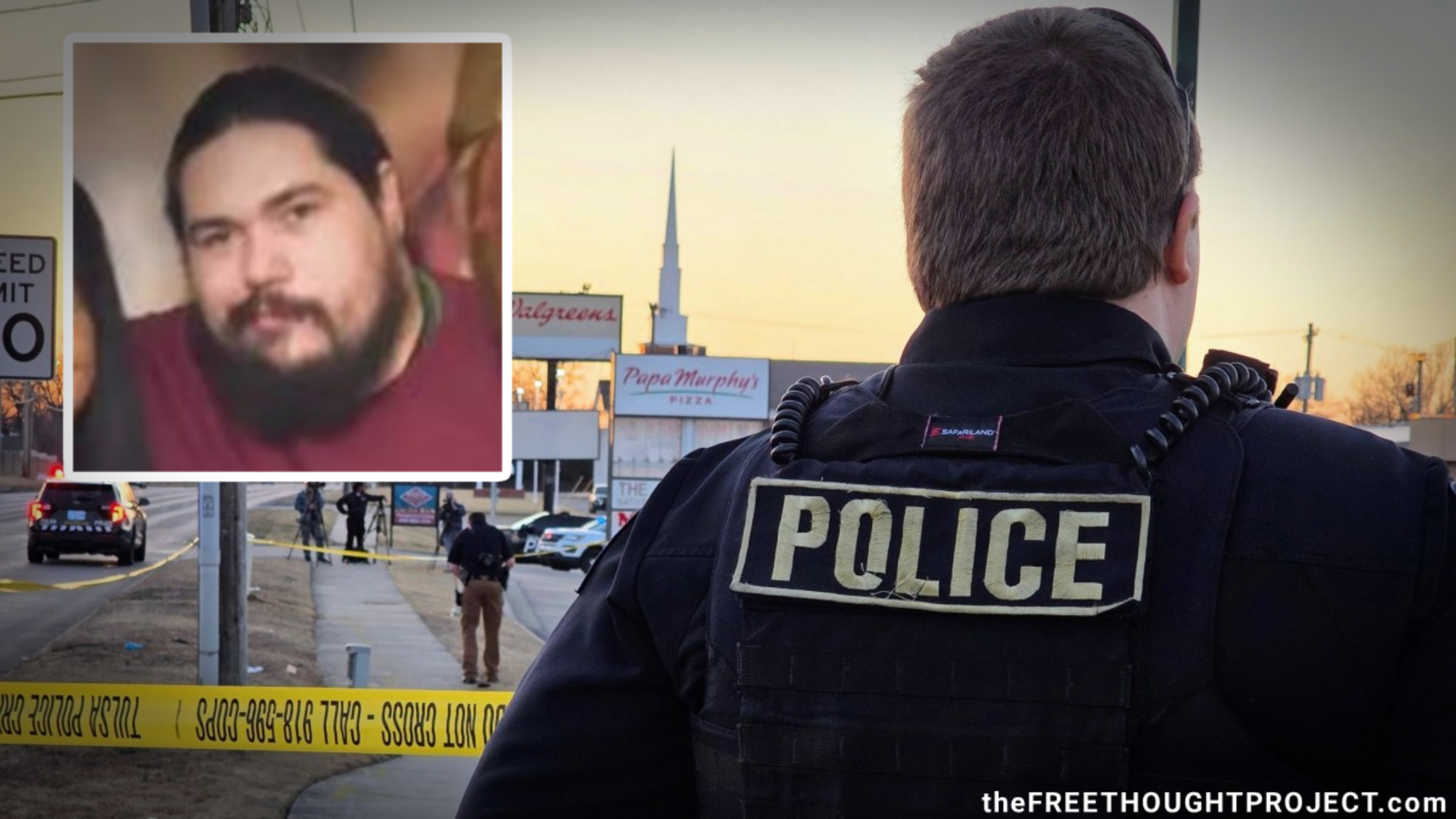


A second look at the Tulsa PD shooting in February and their pattern around use of force during mental health crises.
(Joshua Coulson) February 8th, 2026. The day this family’s entire world was irreparably shattered. It began as many Sundays do for Americans in Oklahoma. Debbie Tyler went to church, listened to the sermon, and shared smiles and hugs with her congregation. On the way home, it was clear that Michael, Debbie’s 33 year old autistic son, was in a state of distress. He wasn’t answering his phone. Knowing this was entirely out of the ordinary for Michael, she rushed home only to find him missing.
Despite the support he was receiving for his depression and PTSD, he had been struggling to cope with the state of the nation. He was witnessing masked agents kidnapping people from their homes. Like any empathetic individual, he struggled to reconcile the helplessness he felt while innocent people were suffering. His support system was there. His family did everything they could to get him the help he needed. Doctors even doubled his medication when he started telling them he no longer possessed a will to live. They made him “pinky promise” that he’d be okay and sent him on his way.1
“Though his medications were doubled and he was going to therapy, it just was not enough to quiet the storm.” Karmen Glunt, Michael’s sister wrote on the GoFundMe dedicated to his funeral costs.
He texted a cryptic message to his friend and took a walk. Upon discovering her handgun was missing, Debbie knew she needed to act quickly to prevent Michael from harming himself. She called a few family friends and began the search. Shortly before 4:30 PM, a family friend located Michael slowly meandering 51st Street near their home in Tulsa. Debbie drove up alongside him and asked him to get in the car. Michael refused in the way he often does when he shuts down emotionally, shaking his head and staying quiet. He eventually tossed his phone into her car and said “I’m not gonna need this anymore, momma”.1
“I need help. Please don’t hurt him, I just don’t want him to hurt himself.” Debbie Tyler pleads with the 911 operator.1
Terrified she might lose her beloved son, Debbie dialed 911. She explained the situation, his condition, and told them he was in a mental health crisis where he might harm himself. She thought they could de-escalate to bring him back from the brink of suicide. According to the official record, 911 operators reported this as a “Suicidal Subject”. The Call Type listed uses the code “SUISUB”
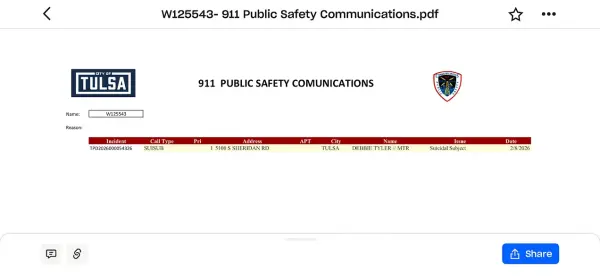 Karmen Glunt’s Facebook">Dispatch information regarding the 911 call for Michael Glunt, 2/8/26. Screenshot from Karmen Glunt’s Facebook
Not every altercation ends the same when police respond to a mental health crisis. Ryan Broostin who arrived first on the scene at approximately 4:32 PM would have been informed that this was a suicidal autistic man. It’s unclear what exact information he was given by dispatch, but what is clear is that his presence escalated this mental health crisis to a fatal encounter.
Different departments show different results.
Police can de-escalate
In stark contrast to Tulsa PD’s actions, Miami-Dade Sheriffs recently showed that police are in fact capable of de-escalation. Celebrity gossip blogger Perez Hilton recently live streamed disturbing acts of self-harm on TikTok. Police responded and arrived on scene but quickly backed off and let medical professionals get him the help he needed.
The difference? This is a high-profile case involving a famous influencer. Some will argue: “Hilton had a knife; Glunt had a gun!”. Anthoneil Williams II had a water bottle. There was never a weapon in sight when Austin PD fired multiple volleys of 9mm rounds at him before and after he hit the ground.
“Suicide” by cop (Law-Enforcement-Assisted Suicide)
In 2019, the Police Executive Research Forum released a new protocol for police to follow, with the aim of reducing cases of LEO-assisted suicide. It emphasizes the need for de-escalation in mental health crises. “Pointing a gun at someone and saying, ‘I’m here to save you,’ it kind of has a mixed message. We should do anything we can to minimize the use of force and maximize the saving of lives.” Los Angeles Police Chief Michel Moore said in a news conference.
The guide titled “Suicide by Cop: Protocol and Training Guide”, more or less states that you can throw the whole thing out the window if the subject has a gun. The need for de-escalation is clear. What isn’t clear is what impact this policy made on average cases compared to high-profile cases like Perez Hilton. There seems to be no national reporting on LEO-assisted suicide statistics. According to The Washington Post, experts estimate around 10% of fatal officer-involved shootings are intentionally instigated and labeled as LEO-assisted suicide. The article from 2019 shows a similar value to the only known study on the topic; In 1998, researchers concluded that 11% of fatal officer-involved shootings in Los Angeles between 1987 and 1997 were cases of LEO-assisted suicide. The figures offered by the guide itself are an extremely wide range, further proving that these statistics and policies need re-evaluation.
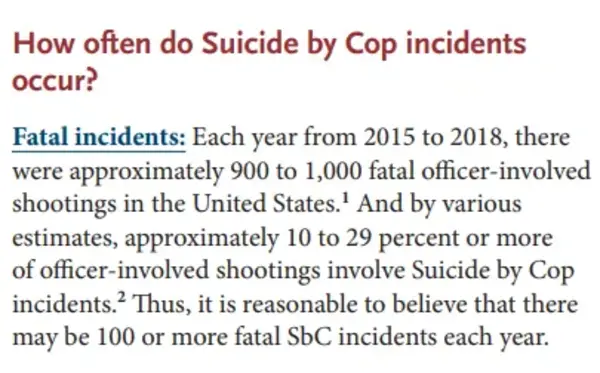 Suicide By Cop: Protocol and Training Guide” Page 1">“Suicide By Cop: Protocol and Training Guide” Page 1
A fatal pattern of mental health crises
Anthoneil Williams II
On July 24th, 2026, Anthoneil Williams II was experiencing a clear mental health crisis. He called the police on himself and told them there was a person matching his own description, with a gun at a park in Austin, Texas. Anthoneil did not have a gun. When the police arrived, he quickly pulled up his shirt and reached toward his waistband. Austin PD immediately gave him exactly what it appeared he was looking for. Except he wasn’t armed. The only thing in his waistband was a water bottle. So why would police grant him an LEO-assisted suicide when he wasn’t even armed with any kind of weapon?
Police accountability advocates might find it strange that Austin PD released this bodycam footage on the same date as the shooting. This in contrast to the case of Michael Glunt, in which Karmen Glunt received notice it would take up to 8 months to receive any footage relevant to the fatal shooting of her brother.
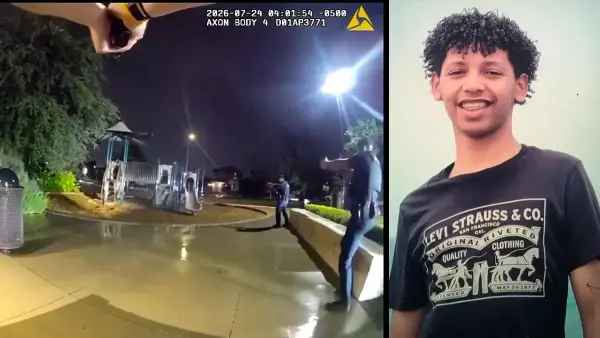 Austin PD Bodycam, GoFundMe dedicated to Anthoneil’s funeral costs">Photo: Austin PD Bodycam, GoFundMe dedicated to Anthoneil’s funeral costs
Glenn Eugene Reed
Tulsa PD is no outlier in fatal encounters. Just one day before the tragic death of Michael Glunt, on Saturday February 7th a man Tulsa PD identified only as “homeless man” was shot and killed after allegedly threatening police and bystanders with a machete. His name is Glenn Eugene Reed.
“Glenn was my former fiancé. He was sweet and kind, and a beautiful soul when he was on his medication. I wish I had been able to save him, I loved him. I hope he’s at peace now with his mom, heartbroken.” Anastasia Thomas wrote on his obituary.
A Twitter account associated with Anastasia Thomas, allegedly Glenn’s ex-fiancé, claims Glenn suffered a traumatic brain injury. Though she doesn’t identify it as a cause, she claims Glenn was suffering from severe mental illness including delusions.
It’s unclear whether this was described as a mental health crisis by dispatch, but it does appear to be a mental breaking point for Glenn. It could have been another case of LEO-assisted suicide. There is alleged footage of the incident, but at the time of publication no video was found.
This pattern isn’t exclusive to Tulsa
On November 18th, 2025, Albert Benson was having a mental health crisis in Oklahoma City. Police were responding to an assault call, where they found one victim with a significant injury. They were unable to locate the suspect at the scene, but a short while later they found him nearby holding a machete. Officers approached Albert at approximately 3:42 AM and chased him down the street for approximately two minutes. Police repeatedly shouted “Dion” while Albert waved his machete over his head shouting “Kill me! Kill me!” and retreated down the street, until he was cornered at a local shop. At approximately 3:44 AM officers began shooting Albert with pepper balls while shouting at him to drop the machete. He continued to shout “Kill me!” repeatedly throughout the entire encounter. After getting hit with several pepper balls, Albert ran toward the officers, and was fatally shot.
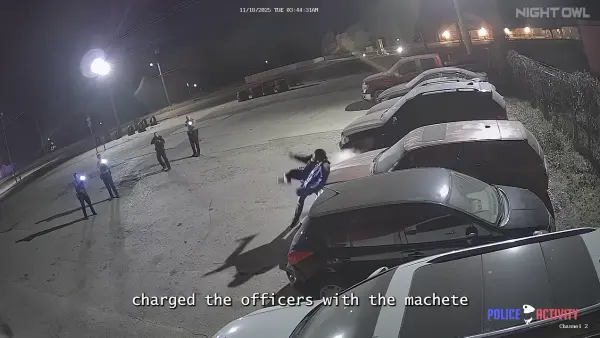 their coverage of Albert Benson">Photo: Screenshot of YouTube Channel “Police Activity” from their coverage of Albert Benson
It’s important to note that when you advocate for a better, more well-trained police force, that doesn’t mean you align yourself with criminal activity. That’s a fallacy. If Albert did in fact hurt someone, a mental health assessment wouldn’t prevent him from catching charges. That’s what the court system is intended for. This incident appears to be another clear example of LEO-assisted suicide. The police just gave him what he was begging for the entire time. That’s not justice, and it doesn’t align with the protocol laid out by the Police Executive Research Forum in 2019.
The Wrap
The potentially fatal risks associated with having a mental health crisis under an oppressive police state don’t end when the subject is successfully restrained. In some cases, that could be the reason the encounter turns fatal. Bloomberg Law recently identified 41 cases where law enforcement used a device known as “The Wrap” on someone who died. The 22-page manual for this device lists several disclaimers for medical emergencies where the wrap should be used with significant discretion to prevent loss of life. The biggest concern among them seems to be respiratory restrictions which The Wrap could impose on the subject if deployed incorrectly.
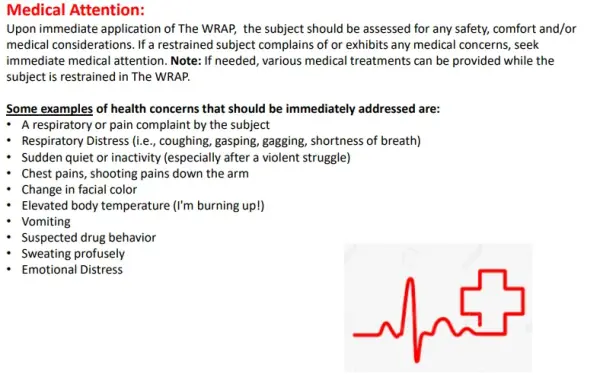 “The Wrap Application Manual by Safe Restraints Inc. “Dedicated to saving lives!”” Page 5">“The Wrap Application Manual by Safe Restraints Inc. “Dedicated to saving lives!”” Page 5
Bloomberg Law found 32 out of 41 cases where officers or guards failed to follow the instructions laid out by the manufacturer, Safety Restraints Inc., according to their analysis. Each time, people became unresponsive while in the device, or soon after it was removed.
A representative for Safety Restraints Inc. named Jennifer Donahoe told Bloomberg Law that no autopsy reports attribute their cause of death to The Wrap. Donahoe also said that reporters are creating a false narrative, citing their lack of litigation as proof that The Wrap did not cause any injuries.
Justin Benner died within 20 minutes of being restrained by The Wrap
On September 18th, 2025, less than 5 months before Michael Glunt was killed, Tulsa PD responded to an unarmed man experiencing a mental health crisis. Justin Benner had been experiencing episodes of paranoia, and that day his father brought him in for a psychiatric evaluation. Doctors had cleared him to return home, indicating that they did not believe he was a risk to himself or others. Unfortunately, his crisis had escalated that night when he was found rolling around in his neighbor’s flower bed shouting nonsensical things.
“I don’t want him to go to jail. I wish I had realized it was my neighbor; I would have tried to help him.” The 911 caller was heard saying on bodycam footage. “We would have not called you guys.”
Bodycam footage shows officers arriving on scene at approximately 10:46 PM. By 10:48 they can be seen firing multiple pepper ball rounds at him as he rolls around tangled up in a thin garden fence. He had no weapon and didn’t appear to threaten anyone, but he didn’t immediately respond to their commands to crawl toward the officers. It doesn’t appear that Justin had any understanding of the situation he was in. He was in desperate need of medical attention. Not only for the apparent mental health crisis, but according to one officer’s words, Tulsa PD had caused some of the wounds Justin had suffered.
“Damn dude, like his stomach is gashed where he got hit with that pepper ball. It looks pretty nasty.” an officer can be heard saying on bodycam footage.
Multiple officers can be heard throughout the ordeal mentioning a medical check that Justin should have received immediately upon his arrest. He received no medical attention while he was alive. Tulsa Police brought him into Tulsa Municipal Jail and restrained him in The Wrap. While they deployed The Wrap, Justin can be seen shaking, having trouble breathing, and can be heard saying “Help me” through short breaths. After they contorted his body to fit into the device, they laid him on his side in a cell where they poured water over his face. They placed a helmet on his head and left him there on the cement floor shaking. He laid there for 15 minutes convulsing before he stopped moving. It took 54 minutes before they checked on him, despite several officers and guards looking into his cell throughout that time frame. Tulsa’s medical examiner could not determine a cause of death, but listed these contributing factors: heart disease, being restrained, physical trauma and methylphenidate, the ADHD medication Justin was prescribed. While they are attending to the death in custody, another detainee can be seen entering the facility already restrained in The Wrap. It’s not unreasonable to conclude that this pattern of use should be evaluated to prevent further loss of life.
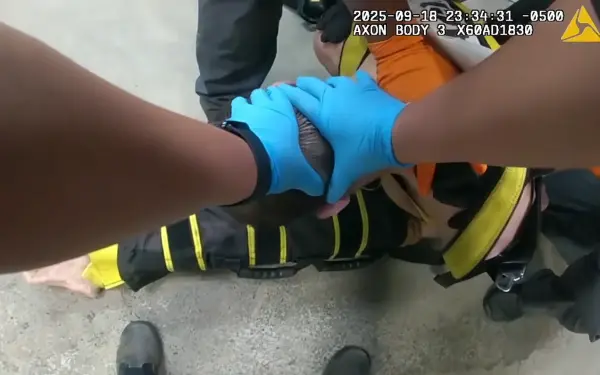
Tulsa Municipal Jail
The city’s jail has a capacity of 70 detainees, has no on-site medical staff, and according to The Frontier, Justin Benner was one of 7 deaths in their custody since 2023.
Brian Bonner was an Oklahoma City local who suffered from Schizophrenia and Bipolar Disorder. His mother Carla states that in the summer of 2024, Brian had lost access to his prescription medication due to a delayed psychiatric appointment.
“I woke up one morning and he was just gone,” Carla said. “That was part of his illness.”
Carla had searched for months but didn’t know he was in Tulsa until the State Medical Examiner’s Office called her in February of 2025 to disclose his death. She tried calling the Tulsa Police Department several times for answers regarding his death but never heard back.
In the 5 months leading up to his death, Brian had been booked into lockup 11 times for misdemeanor crimes allegedly related to homelessness and untreated mental illness. On February 14th, 2025, Brian was arrested following a call from a Downtown Tulsa steakhouse owner for smoking in the lobby. The restaurant owner clarified that they didn’t want Brian to go to jail, just that he had to leave. Despite officers reporting that he was intoxicated in public, they refused to bring him to the city’s Sobering Center. Tulsa has a place where detainees under the influence receive medical attention, and it’s an important step to ensure intoxicated individuals don’t suffer from a fatal overdose. Bodycam footage reviewed by The Frontier captured an officer asking if they should bring Bronner to the Sobering Center, and another can be heard replying “Nah”.
Brian was suffering from two medical emergencies when was booked into the Tulsa Municipal Jail. There was an apparent mental health crisis, but he also had an infection in his throat that desperately needed treatment. They scheduled a telehealth appointment for Brian, but he would ultimately succumb to his infection on February 17th. He received no medical attention while he was alive. The state medical examiner determined Brian’s cause of death to be acute laryngo-epiglottitis, an infection that can be easily treated with antibiotics.
Carla Bonner has filed a federal lawsuit against the City of Tulsa, a private security contractor and the Tulsa Municipal Jail administrator for ignoring years of warnings about the dangerous conditions inside the jail. One of those warnings came from Ivy Morgan, a detention officer working for the jail. Morgan raised concerns about dangerous levels of understaffing in the prison, and the lack of medical staff and resources for detainees that need it.
“I told them, ‘If this keeps happening, people are going to die. Someone’s going to get hurt. The whole bottom is going to fall out.’” Ivy Morgan said after resigning.
Ivy Morgan was one of many jail staffers that raised concerns to Allied Universal, the private security company that operates Tulsa Municipal Jail under a $3 million annual contract.
“It’s hard to explain the extent of some of what you saw, unless you were there. There were times I took people’s boots off and had toes come off with them. You had people coming off hard drugs, chest pains, suicidal ideation.” said Timothy Robertson, a former supervisor at the jail.
At the time of publishing, there were no updates on Carla Bonner’s lawsuit.
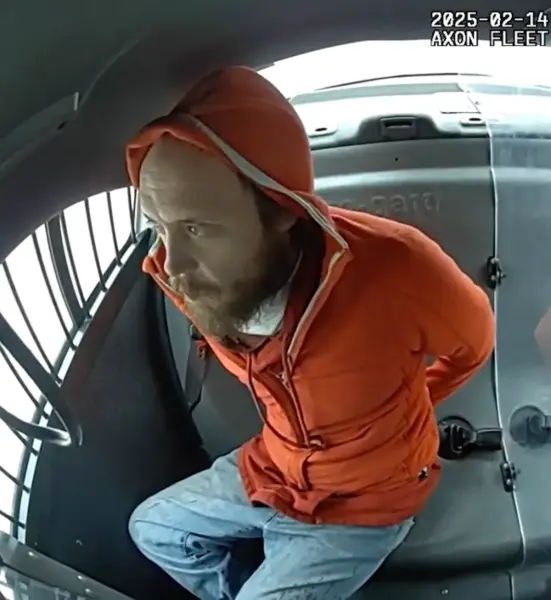 The Frontier">Brian Bonner on his way to Tulsa Municipal Jail. Source: The Frontier
A closer look at the killing of Michael Glunt
Ryan Broostin didn't turn on his bodycam on February 8th
Bodycams can often help with investigations but for whatever reason they are frequently not turned on when they could be used to hold a police officer accountable for their actions. According to police, the vehicle’s emergency lights activate their built-in dash camera, and unholstering their sidearm activates their bodycam. Broostin used a rifle and did not activate his emergency lights. The only bodycam footage offered by Tulsa PD was released likely in the interest of justifying the shooting, despite containing several inaccuracies repeated throughout. Most of those details came from Ryan Broostin himself. Verbally relaying them to the officer that arrived second, after the shooting had occurred. Ryan told his fellow officer that he shot Michael Glunt “two or three times” after Michael fired first.
Over the next ten minutes of bodycam footage, several officers arrive shouting commands at Michael who lay on the ground, mostly out of frame of the bodycam footage. It’s unclear if he was physically able to respond to those commands after being shot 9 times. While they discuss moving towards Michael with their shield, a voice in the background can be heard saying they would provide medical assistance when they approach. The officer wearing the bodycam cuts them off saying “shut up”. They eventually approach Michael who is groaning in pain, speaking between breaths.
“I’m a goner. It’s okay, I did what I had to do.” Michael Glunt can be heard saying as he lay on the sidewalk.
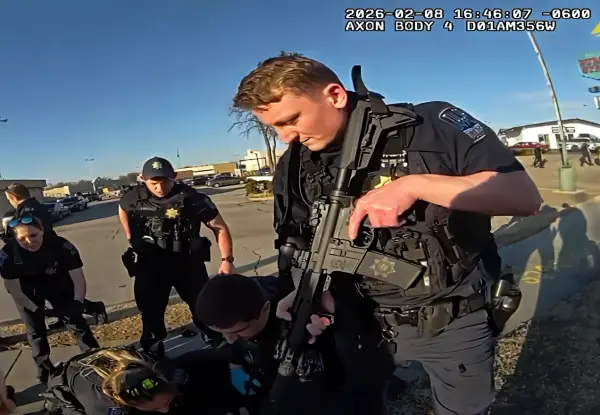 Bodycam">Ryan Broostin, Tulsa PD stands over Michael Glunt having just shot him 9 times. Source: Bodycam
While writing this article, a phone interview was conducted with Karmen Glunt, Michael’s sister. Karmen has been shouldering the task of collecting all the available information on the shooting and working toward a safer community in Tulsa. As part of the interview, Karmen was asked “What do you think was going through Broostin’s mind as he smiled over Michael and continued pointing his rifle even after Michael was handcuffed?”
“I’ve asked myself that question a lot. He’s a young kid. I think he’s 25 or 26, only been a cop for 1 or 2 years. I don’t think he had ever shot anybody before. I’ve tried to understand why he still has his gun on my brother’s face, why he’s looking at him like that. As much anger and rage that I have about how this situation was handled on his part, I feel like reality hit him when he heard my brother, and he had to walk away, and then he wanted to talk to his mom. He’s a kid.” Karmen Glunt explains during an interview.1
Ryan Broostin standing over Michael with a smile, as if he had just taken down a 10-point buck, was just one moment in the 39 minutes of bodycam footage. Upon reviewing the remaining footage, you can see a few peculiar segments that might seem insignificant at first glance but could point to serious internal policy issues. The first comes as an unidentified officer appears to step right into the pool of blood that was left after they lifted Michael into an ambulance. He addresses the officer wearing the bodycam: “Were you shot at?” he asks, addressing the bodycam wearing officer as “Perry”. Perry clarifies that it was Broostin, and that Broostin does in fact claim he was shot at. The unidentified officer then leaves the scene. The officer appears to have no regard for the biohazard he is immediately spreading to the patrol car he walks to. Is Tulsa PD being trained on how to handle a crime scene?
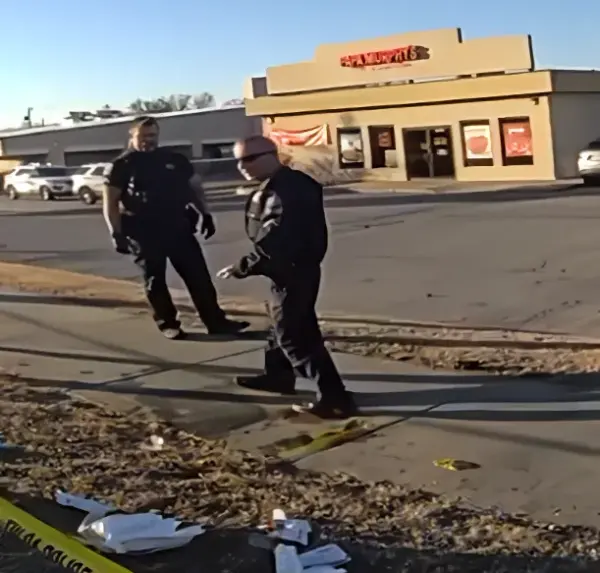 Bodycam">Unidentified officer, Tulsa PD standing in a pool of blood. Source: Bodycam
The next eyebrow raising moment in the footage is not so much about what we see or hear; it’s what we don’t hear. At approximately 24:34 in the video, officer Perry recites his personal phone number to another officer. “713-” The footage is then muted, presumably to redact sensitive personal information. The audio briefly unmutes at approximately 24:53 where we hear a barely audible whisper. Then at approximately 24:59, the audio fully resumes. While this brief whispering exchange occurs, a third officer walks up and gives Perry his full attention, to what is allegedly just his personal information. The third party appears to turn a knob on his radio until the whispering exchange is over and then turns it back. There is no real conclusion we can draw from this behavior, but it’s not unreasonable to assume that more than just a 7-digit phone number was recited in that 25 second exchange. This raises a serious question about their redaction policy. Are officers purposely using moments like these to redact information that would be relevant in an internal investigation?
The facts in the case don’t add up
Tulsa PD had initially reported that when Broostin ordered Michael to remove his hands from his pockets, he pulled out a revolver and pointed it at Broostin. That was the only publicly available detail while the DA conducted an internal investigation and concluded that Broostin was justified in shooting Michael. After Broostin was cleared of all wrongdoing in April, Tulsa PD’s Captain Richard Meulenberg gave The Oklahoma Eagle the story that was told on scene by Broostin: Michael fired first. Meulenberg mentions this was corroborated by two eyewitnesses that were allegedly tracked down using local security camera footage.
“The witnesses that were eating there, the father and daughter that were eating burgers for the Super Bowl…” Karmen Glunt said in a recent Facebook video. “they told me after they talked to police that they don’t even think they saw my brother shoot his gun.”
Karmen goes into great detail in her recent video. She offers a new piece of evidence that might suggest Michael couldn’t have fired first. In the parking lot where Broostin positioned himself, there is a large sign where a group of birds were resting. Based on the clip she provided, it does appear the birds fly away only after Broostin starts firing his rifle.
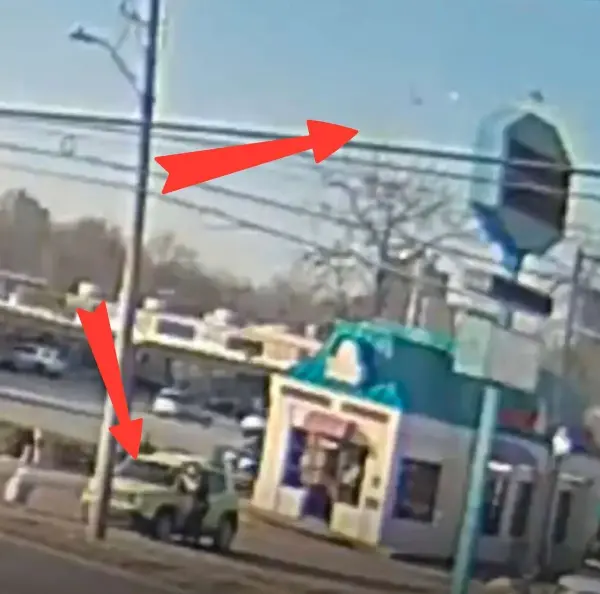 Karmen Glunt’s Facebook">Birds seen fleeing after Broostin fires. Screenshot from Karmen Glunt’s Facebook
Among consistently repeated claims made by Tulsa PD’s Captain Richard Meulenberg were two major discrepancies:
- “Michael was shot 1-3 times.” Evidence at the scene suggests Broostin fired a dozen rounds, and the medical examiner identified 9 distinct entry wounds.
- “The 911 call didn’t detail a suicidal man.” Not only did officers on scene corroborate dispatch relaying “suicidal man with a gun”, but the actual 911 call record states as much.
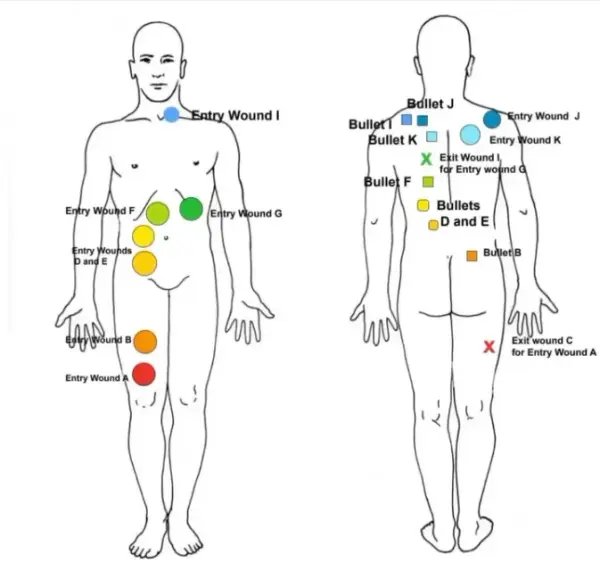 Karmen Glunt’s Facebook">Medical examiner’s report on Michael Glunt. Screenshot from Karmen Glunt’s Facebook
When Michael’s family obtained the medical examiner’s report, they finally got their first transparent piece of information. It completely challenged the narrative that Tulsa PD had been asserting on the news. Michael has 9 distinct entry wounds, and 7 projectiles were recovered by the medical examiner.
Among the gruesome details of just how effectively those bullets tore Michael apart, the medical examiner’s report appears to have an entire section missing. If Broostin is telling the truth, a test for gunshot residue would surely prove beyond a reasonable doubt that Michael fired the revolver. Instead, the entire “MICROSCOPIC EXAMINATION” section where you’d see results for a GSR test reads: “A microscopic examination is not performed.” Is this simply a horrible oversight? Or is it evidence of a broken system that can barely hold itself together?
 Medical examiner’s report on Michael Glunt. Courtesy: Karmen Glunt
Local news reporting on scene captured the moment Tulsa PD had identified the 12th bullet casing ejected from Ryan Broostin’s AR-15 service rifle. The footage cuts off just as the 12th marker is being placed. We can confirm what investigators are marking with officer Perry’s bodycam.
“Damn, who fired more than twice?” Perry asks, confused by the number of casings on the ground. “I see 5, 6…7. We didn’t have anything get past him? Don’t have anything hit down there that we’re aware of?”
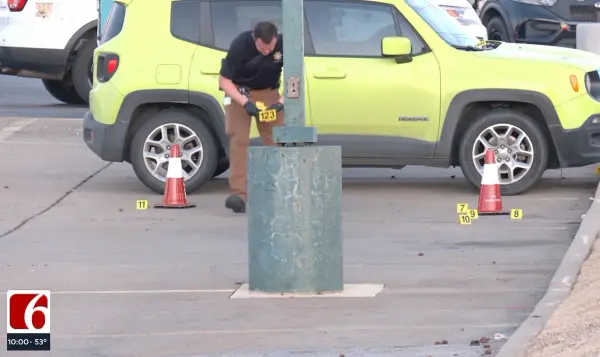 News On 6">Tulsa PD investigators mark bullet casings found on scene. Source: News On 6
Upon reviewing the bodycam footage, the officers clearly identified that the next piece of evidence closest to them is a holster. More on scene footage does indeed show that #13 is the holster, followed by #14: the knife Perry pulled out of Michal’s pocket, and #15: the revolver.
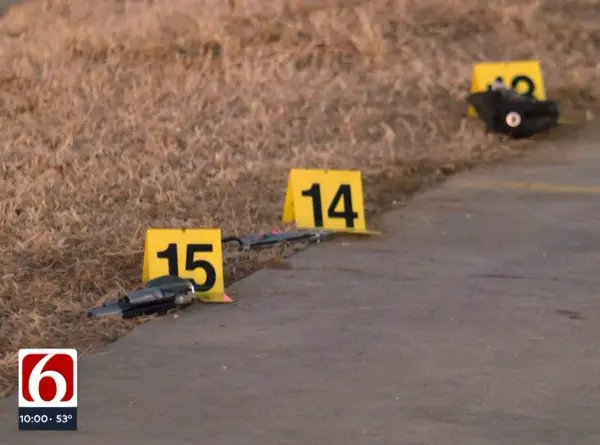 News On 6">Evidence marked by Tulsa PD. Source: News On 6
Despite media outlets showing a dozen shell casings being cataloged, Captain Richard Meulenberg continues to repeat the claims asserted at the scene. In multiple interviews he can be heard repeating that 1-3 shots were fired, and that the issue was somehow more complex than a suicidal man with a gun. Tulsa PD’s statement described it simply as a “Man with a gun” call. He seems to stumble over his words in a KJRH interview regarding the 911 call, published just 4 days after the fatal shooting.
“When you do get that call, someone who is a danger to themself because of their own mental health issues, can you briefly explain what that protocol is for responding officers?” Samson Tamijani of KJRH, 2 News Oklahoma asks.
“Sure, but that wasn’t the call. Right? Can we…that’s…the call wasn’t ‘he’s a danger to himself’. Is that correct?” Captain Meulenberg asks and quickly speaks again before Samson can answer. “What’s I’m asking what is-what is-I-I-cuz’ I didn’t see your interview, what are the-what did the parents say?”
“She explained that she’s worried for him because he never leaves the house, and that he has a history of PTSD and suicidal thoughts, and he took her gun from their apartment.”
“Okay, so there are some other components of that, where he had uh, a lot of anti-ICE, immigration, you know uh, statements that he had made in-there was, you know that we had learned. You know this was after the fact uh, but what the officers knew going in was that he had a loaded gun, he was walking the area, and he’s going to do something he can’t come back from.”
How the narrative was shaped
Captain Richard Meulenberg repeats this statement often through several media interviews and press statements. He claims that Michael said he was “going to do something he can’t come back from”. All the details given to the press before April when Broostin was cleared were very carefully repeated with no variation. 1-3 shots. Not described as a suicidal subject. Both of these details can be debunked by viewing Tulsa PD’s bodycam release. But why was this cryptic message about “not coming back” repeated? The lack of details around this message is more cryptic than the message itself. Before Michael left his home, he texted a close friend.
“Do you ever know what the right thing to do is, but you wouldn’t come back?” Reads the text message Michael sent to a friend, which Debbie Tyler relayed to the 911 operator.
Tulsa PD carefully repeated the same message. “He’s going to do something he can’t come back from.” They shined a spotlight on his empathy and used it against him. They went digging for “dirt” and his empathy was all they needed to shape the narrative to the public. Somehow without saying it directly, Tulsa PD managed to convince people across the country that Michael had intended to attack an ICE agent. But that doesn’t fit with Michael’s personality, according to the family. Michael wasn’t a violent person. The views he expressed about ICE came from the sorrow he felt seeing his nation crumble under an authoritarian police state. It didn’t come from a place of hatred or a violent nature. It came from a place of love and compassion. The message he sent to his friend was likely because he saw no other way to free himself from this pain.
Many individuals suffer from suicidal thoughts, and that demographic seems to be rising at an unsettling pace. If you or your loved ones are suffering, please know that there are resources available to you. Dial 988 for the Suicide Prevention Hotline, any time you’re in crisis. They can help.
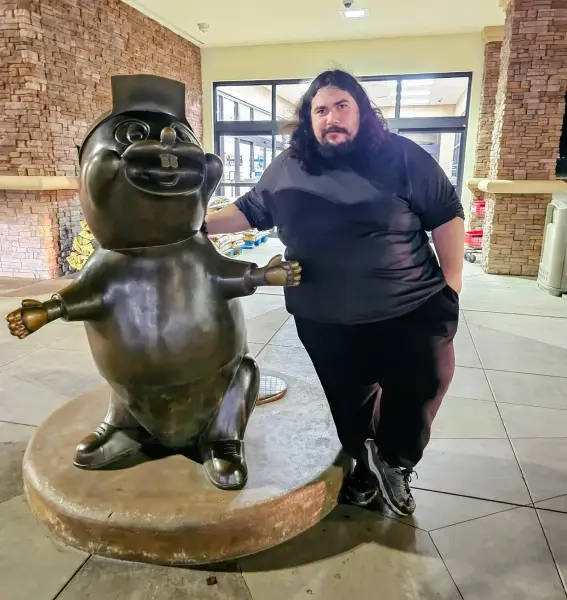 Michael Glunt, described by his mother as a “Gentle Giant” at a Buc-ee’s rest stop. Courtesy: Debbie Tyler
Whoever kills a soul - it is as if he had slain mankind entirely. And whoever saves one - it is as if he had saved mankind entirely. Quran 5:32
The final image in this article might be difficult to look at. It’s a photo of Debbie Tyler mourning her son Michael Glunt during his wake. It might feel strange to witness such an intimate moment, but it highlights the purpose of this article. When we discuss officer-involved killings, please remember that these are human beings. This is your neighbor. They could be your teacher, your nurse, they could be your everything. Michael was a brother, a son, an uncle, and a shining example of a good person to everyone in his life. No matter what conclusion you came to after reading all the details, remember that. Help us build a safer community by showing compassion.
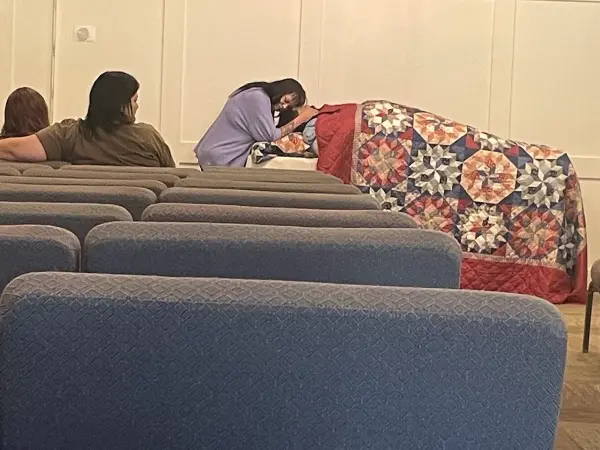 Debbie Tyler mourns her son, Michael Glunt. Courtesy: Karmen Glunt
Rest In Peace Michael Warren Glunt.
1Source: Interview with Karmen Glunt 8/14/26
Excerpts from the interview will be edited and published at a later date.
Researched, compiled, and written by Joshua Coulson
