



A disturbing trend remains on the rise as facial recognition technology continues to wrongfully identify innocent people as criminals.
RENO, NV — Jason Killinger walked into Reno's Peppermill Casino in September of 2023, later that evening as he was exiting the building he would be arrested. The casino's facial recognition system had flagged him as a "100 percent match" for an individual that had previously been banned from the property. The only problem? It was completely wrong.
After the system flagged Killinger, casino security would approach him, referring to him as "Mike", an individual who had been previously removed from the property. Despite his insistence and ability to prove that he was in fact not Mike, security would surround and handcuff Killinger before calling the Reno Police Department. Shortly thereafter rookie Officer Richard Jager would arrive on the scene.
Killinger quickly proved he was not the man identified in the system, as he was carrying three valid forms of identification, including a Nevada Real ID compliant drivers license, his Peppermill player's card, and a debit card, all with his name on it. When this wasn't enough he offered to retrieve more from his vehicle, which included a pay stub, vehicle registration, and a medical card. Despite all of this copious documentation proving who he was, Officer Jager declined to investigate further, not bothering to look at any of his other identifying documents. Killinger would be arrested and charged with criminal trespass.
He would then spend 11 hours in police custody, only after a fingerprint check at Washoe County jail confirmed his identity would he finally be released.
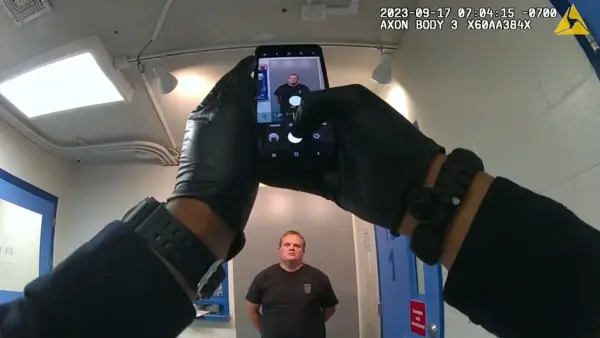 Body camera still frame of Jason Killinger being booked into Washoe County Jail
Jason Killinger's ordeal is now among the focus of a federal lawsuit which alleges Reno police relied on this system to identify suspects for years resulting in thousands of arrests, without any proper training or even understanding how the system works, according to an amended complaint filed April 2nd in US District Court, which names Officer Jager and the city of Reno as defendants.
During the arrest, as Mr Killinger continues to proclaim his innocence and insist he is who he says he is, body camera footage documented in the court filings shows Officer Jager placing a call to his supervisor, Sgt. Carl DeSantis, to inquire about what should be done concerning the contradiction between the facial recognition system and Killinger's identification.
Jager was instructed to arrest him anyway
At which point Officer Jager can be heard saying:
“I just have a feeling he’s got a hookup with the DMV where he’s got two different driver’s licenses that are registered with DMV with different names and different dates of birth, so I’ll arrest him on that.”
Of course, this was not the case. Killinger's driver’s license indicated he was seven years younger, 50 pounds heavier, and four inches taller than the individual they accused him of being, as well as having different eye color and a different category of license (commercial vs. ordinary).
Attorney Terri Keyser-Cooper, representing Mr Killinger in the case, stated:
“Jager’s conduct was not a sporadic incident involving the wrongful actions of a rogue employee, but the result of a widespread custom and practice involving hundreds of municipal employees making thousands of arrests in the same manner over a period of years.”
As it would turn out, "widespread custom and practice" would prove to be an understatement, as court documents would later reveal the Reno Police Department would often request the assistance of the Peppermill Casino to utilize their software to identify suspects. It would also be revealed that Reno PD does not have a policy related to this regularly-used biometric technology.
Speaking with the Reno Gazette Journal, Keyser-Cooper would also state,
“I just knew in my gut the procedure that allowed what happened to Killinger could happen to anyone — you, me, anyone — and it was a dangerous violation of constitutional rights,”
“The ramifications of years of arresting people based solely on FRS (facial recognition software) alone is enormous, and the failure of the city to train its officers when such arrests were being made on a regular basis is outrageous.”
In 2017, the Department of Justice published a policy template through its Bureau of Justice Assistance, which characterizes facial recognition results as “advisory in nature” that “do not establish probable cause.” Explicitly stating that results are not to be treated as positive identification without further investigation. Clearly the Reno Police Department didn't get the message.
Under deposition in January, officer Jager would admit it was RPD's “custom and policy to accept facial recognition by entities or businesses that were reputable” and that other officers similar to himself “were also accepting facial recognition software as accurate for identification purposes.”
Officer Jager has since attended facial recognition software training, stating in the deposition that based on what he has since learned about the technology he would not have made the arrest.
Growing Concerns
This incident is only the latest in a series of false arrests made as a result of misidentification through AI facial recognition.
The Free Thought Project has long documented the misuse and faulty nature of this technology throughout the years, including a 2018 report showing data which indicates that facial recognition systems can be wrong upwards of 90% of the time. As well as highlighting the chilling ways in which facial recognition and biometric integration by the FBI continue to build upon a sprawling illegal mass surveillance network on the federal level, while on the state level police departments across the nation continue to use and rely on this technology outside of imposed restrictions.
The American Civil Liberties Union has notably taken a stance against the integration of facial recognition technology due to frequent misidentifications leading to the violations of civil rights.
Facial recognition tech has been shown to be racially biased, with studies showing that algorithms are between 10 to 100 times more likely to misidentify Black or East Asian individuals compared to white people.
In January of 2020, Robert Williams, a black man from Detroit, Michigan, was falsely arrested after a facial recognition system mistakenly identified him as a shoplifting suspect.
A similar fate befell Randal Reid of Georgia in November of 2022, after a facial recognition program out of Louisiana, where he had never been, falsely identified him as one of three suspects wanted in connection in the theft of over $10,000 of luxury purses out of Jefferson Parish.
More recently, Angela Lipps, a 50-year-old mother and grandmother from north-central Tennessee, was held behind bars for nearly six months due to being misidentified as a larceny suspect from over 1,200 miles away in North Dakota. She had never been to North Dakota a day in her life.
These cases demonstrate a growing concerning pattern. Not only are millions of innocent Americans illegally cataloged in this growing panopticon, but the technology itself remains too faulty to ignore, while those who use it lack the necessary technical understanding to do so. This creates a nightmare scenario wherein innocent people will continue to be misidentified and wrongfully arrested unless citizens begin taking a more active role in demanding this technology not be implemented in their communities.
