

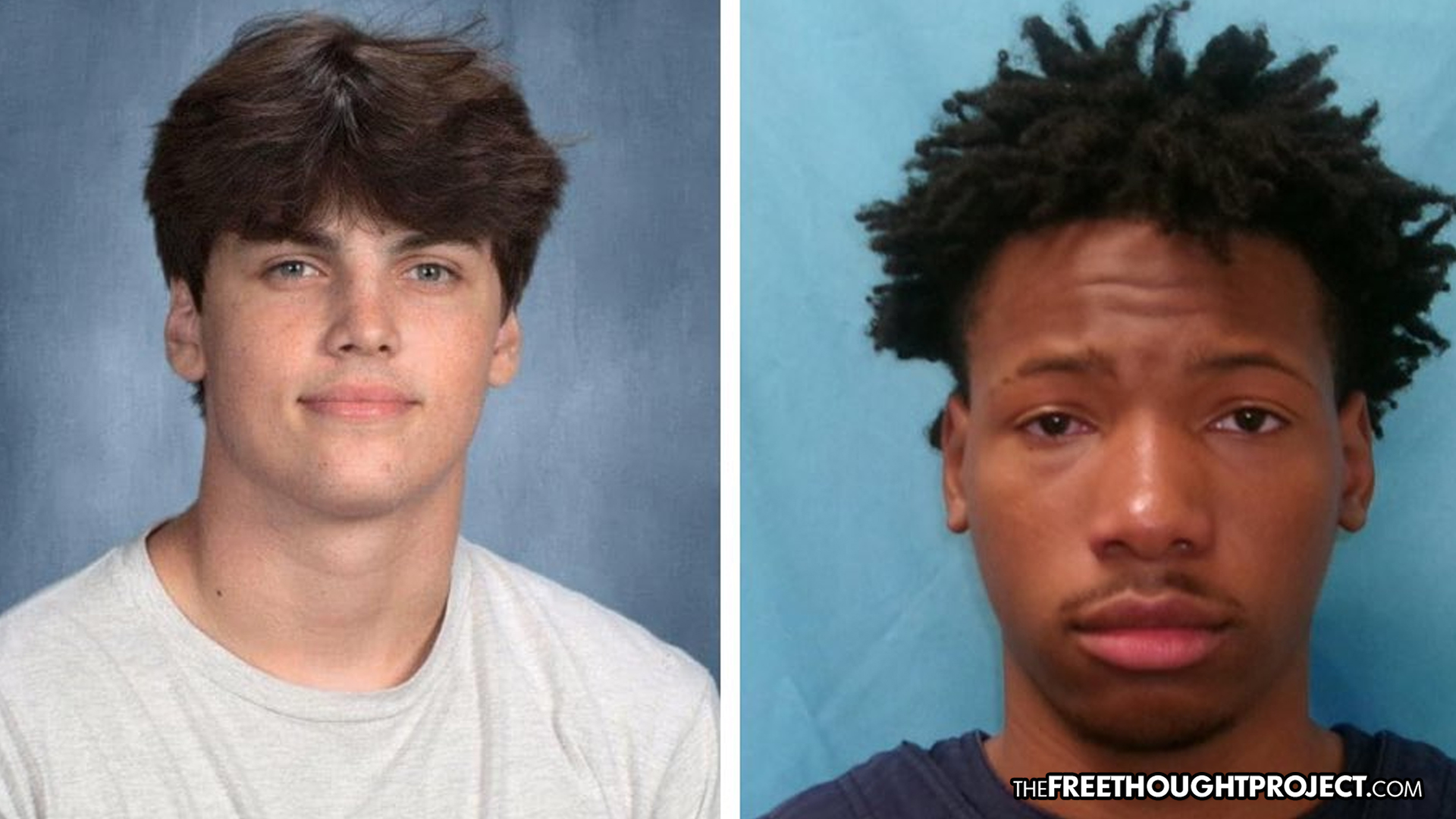


Where logic dies, mobs rise. This case reveals just how far down the rabbit hole we’ve fallen.
FRISCO, TX — A tragedy unfolded in Frisco, Texas this week as a high school track meet became the scene of a fatal stabbing. Seventeen-year-old Austin Metcalf, a promising athlete with dreams of college football, was killed after an altercation with fellow student Karmelo Anthony, also 17, of Centennial High School.
According to the initial police report, which has since circulated widely, Anthony reportedly provoked Metcalf by daring him to "touch me and see what happens" after a verbal dispute escalated. Witnesses say Anthony reached into his bag, opened it, and taunted Metcalf, seemingly inviting confrontation. Moments later, Metcalf physically engaged with Anthony — a decision that, tragically, led to him being fatally stabbed in the chest with what was later described as a black knife.
According to the police report, Anthony did not attempt to hide his involvement when approached by law enforcement. He openly admitted, 'I am not alleged, I did it,' and even asked officers if the incident could be considered self-defense — a notable detail that, while not an exoneration, shows he did not try to fabricate his role in the tragic event.
As this heartbreaking incident sent shockwaves through the community, something predictable happened: social media erupted, not with calls for calm or facts, but with instant, fever-pitched takes that splintered cleanly along political and cultural fault lines.
Fundraisers for the suspect, Anthony, raised hundreds of thousands of dollars in record time. Some of the same voices rallying behind him even took the inflammatory step of claiming the victim "deserved" his fate — an inhumane and deeply troubling sentiment. On the other side, many reacted with equal zealotry, reflexively assuming Anthony's guilt and demanding severe punishment without pausing to examine all of the facts or consider the complex nature of self-defense law.
This is the state of public discourse in America today: reflexive tribalism overrides rational thought, and nuanced, critical analysis is replaced by pre-scripted outrage depending on which "side" you're expected to be on.
But the truth, as it so often is, defies easy categorization.
Yes — self-defense is absolutely justified when a person genuinely believes their life is in immediate danger. But as the police report details, Anthony initiated the confrontation with taunts and challenges, displaying behavior that undercuts the premise of imminent threat. The alleged "touch me and see what happens" remark signals not a man fearing for his life, but one seemingly prepared for violence.
Yet at the same time, jumping to conclusions about Anthony’s intent — or preemptively dismissing the possibility of systemic failures or unseen factors at play — does no one any favors. Emotional outbursts from either side cannot substitute for facts, due process, and critical thinking.
What is unfolding here is bigger than just one tragic incident. It's a cultural phenomenon where people are conditioned to respond to complex events with binary reactions. You’re either "with us or against us," and any attempt to carve out space for nuance is met with hostility from both sides.
This incident should serve as a wake-up call.
We should all be asking deeper questions:
- What led to this level of hostility between two teenage athletes at a track meet?
- How did we reach a point where society instantly polarizes even the most heartbreaking of tragedies?
- And how can we, as individuals, resist the urge to default to emotional narratives before the facts are fully known?
Ultimately, justice in this case must be determined by evidence, not emotion. By courts of law, not courts of public opinion.
For now, we owe it to both Austin Metcalf’s family and Karmelo Anthony’s family to let the process unfold — and to resist the all-too-tempting pull of tribal outrage.
