

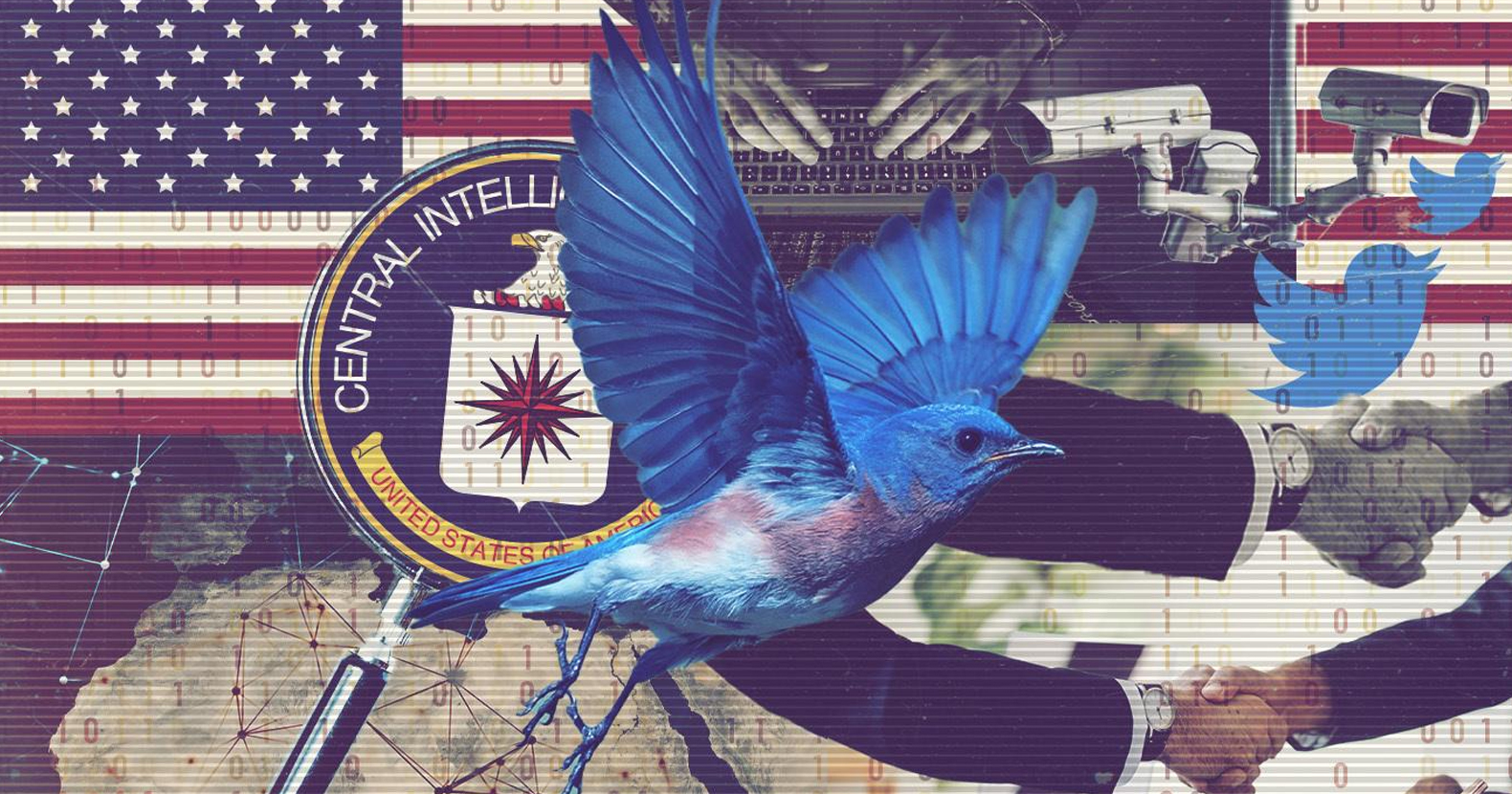


The veil has been lifted on a secret alliance between Silicon Valley, intelligence agencies and the political establishment
In 1975, the Church Committee managed to take a fleeting, if far from complete, snapshot of the netherworld in which agencies such as the Central Intelligence Agency (CIA), Federal Bureau of Investigations (FBI) and National Security Agency (NSA) operate.
In the aftermath of the Watergate scandal, the congressional committee and other related investigations found that the country’s intelligence services had sweeping surveillance powers and were involved in a raft of illegal or unconstitutional acts.
They were covertly subverting and assassinating foreign leaders. They had coopted hundreds of journalists and many media outlets around the world to promote false narratives. They spied on and infiltrated political and civil rights groups. And they manipulated the public discourse to protect and expand their powers.
Senator Frank Church himself warned that the might of the intelligence community could at any moment “be turned around on the American people, and no American would have any privacy left, such is the capability to monitor everything … There would be no place to hide.”
This is why establishing a new Church Committee is long overdue. And finally, in the most controversial of circumstances and for the most partisan of reasons, some sort of revival may finally be about to happen.
A protracted battle last month within the Republican Party to elect Kevin McCarthy as the new speaker of the House of Representatives forced him to cave to the demands of his party’s right wing. Not least, he agreed to set up a committee on what is being called the "weaponisation" of the federal government.
It held its first meeting last week. The panel said its task would be to look at "the politicization of the FBI and DOJ and attacks on American civil liberties".
Earlier, in a speech to the House on the new committee, Republican Representative Dan Bishop said it was time to cut out the “rot” in the federal government: “We’re putting the deep state on notice. We’re coming for you.”
Snowballing powers
But while the committee will almost certainly end up being used to settle political scores, it may still manage to shed light on some of the terrifying new powers the security services have accrued since the Church Committee’s report.
The degree to which those powers have snowballed should be obvious to all. Documents leaked by whistleblower Edward Snowden a decade ago showed illegal mass surveillance at home and abroad by the NSA. And Julian Assange’s transparency organisation Wikileaks published dossiers not only revealing US war crimes in Iraq and Afghanistan, but a huge global hacking programme by the CIA.
Notably, in what may be a sign of the power of the security agencies to inflict retribution on those challenging their might, both Assange and Snowden have suffered dire consequences.
Snowden has been forced into exile in Russia, one of the few jurisdictions where he cannot be extradited to the US and locked away. Assange has been jailed as US authorities seek his extradition, so he can be disappeared into a maximum-security prison for the rest of his life.
Now, in an unlikely turn of events, a billionaire has opened another window on covert manipulations by the security services - this time in relation to social media platforms and the US electoral process. The key players this time are the FBI and the Department of Homeland Security (DHS), set up by former President George W Bush’s administration in the wake of the 9/11 attacks.
After he bought the social network Twitter last year, Elon Musk gave a handful of independent journalists access to its corporate archives. In a continuing series of investigations named the Twitter Files, published as long threads on the platform, these journalists have been making sense of what was going on under Twitter’s previous owners.
The bottom line is that, after Trump’s election, US security agencies - aided by political pressure, especially from the Democratic Party - aggressively wormed their way into Twitter’s decision-making processes. Other major social media platforms appear to have made similar arrangements.
A 'nothingburger'?
The Twitter Files suggest a rapidly emerging but hidden partnership between state intelligence services, Silicon Valley, and traditional media, to manipulate the national conversation in the US - as well as much of the rest of the world.
The parties in this alliance justify to each other their meddling in US politics - concealed from public view - as a necessary response to the rapid rise of a new populism. Trump and his supporters had come to dominate the Republican Party, and a populist left headed by Senator Bernie Sanders had made limited inroads into the Democratic Party.
Social media attracted particular concern from the security services because it was seen as the vehicle that had unleashed this wave of popular discontent. According to a report in the Intercept, one FBI official remarked last year that “subversive information on social media could undermine support for the US government”.
The national security state, it seems, viewed an alliance with the Big Tech private sector as an opportunity to protect the old guard of politics, particularly in the Democratic Party. Figures such as President Joe Biden and former House Speaker Nancy Pelosi were seen as a safe pair of hands, positioned to preserve the legitimacy of a turbo-charged, neoliberal capitalism, and the forever wars that have been the lifeblood of the intelligence community.
This partnership has served all sides well. Silicon Valley has been the career of choice for many liberals who believe that progress is best pursued through technological means that depend on social stability and political consensus. Populism and the polarisation it engenders naturally discomfort them.
And both the security services and more centrist politicians in the Republican and Democratic parties understand that they are in the firing line in populist politics for decades-long failures: a growing polarisation of wealth between rich and poor, a creaking US economy, depleted or non-existent welfare services, the ability of the rich to buy political influence, the constant loss of treasure and life in seemingly pointless wars fought in far-off lands, and a media that rarely addresses the concerns of ordinary people.
Rather than focusing on the real causes of growing anger and anti-establishment sentiment, the security services offered politicians and Silicon Valley a more comforting and convenient narrative. The populists - on the right and left - were not articulating a frustration with a failing US political and economic system. They were working to sow social discontent to advance the interests of Russia.
Or as the minutes of a DHS meeting last March recorded, the new focus was on curbing “subversive data utilized to drive a wedge between the populace and the government”.
This strategy reached its zenith with “Russiagate”, years of evidence-free hysteria promoted by the intelligence community and the Democratic Party. The central claim was that Trump was only able to defeat his Democratic rival Hillary Clinton in the 2016 presidential election because of collusion with Moscow, and Russian influence operations through social media.
As in a game of whack-a-mole, any signs of misconduct or criminality by the security services, or systemic failures by the US political class, were now knocked down as “Russian disinformation”.
Snowden’s exile to Russia - the only choice left to him - was used to discredit his whistleblowing on the NSA. And the disclosures by Assange and Wikileaks of war crimes and lawbreaking by the intelligence community were effectively negated by a supposed collusion with “Russian hackers” in revealing corruption in the Democratic Party during the 2016 election.
In practice, claims of “Russian disinformation” simply served to further polarise US politics.
The key issues raised by the Twitter Files - of deep-state collusion with the tech and media industries, election meddling, and narrative manipulation and deflection - have been subsumed within, and obscured by, political partisanship.
Interest in the Twitter Files has been largely confined to the right. In knee-jerk fashion, Democrats have mostly dismissed the revelations as a “nothingburger”.
Climate of fear
Perhaps coincidentally, Musk has found himself transformed since his takeover of Twitter from a darling of liberals - for his Tesla electric cars - into a near-pariah. In October, the Biden administration denied reports that it was considering a national security review of his businesses in the face of Musk’s “increasingly Russia-friendly stance”. His status as the world’s richest man has rapidly collapsed alongside his reputation.
The irony is that the same security agencies that whipped up the “Russiagate” hysteria are now exposed in the Twitter Files as perpetrating the very interference of which they accused Moscow.
During the 2016 presidential election, Russia was said to have colluded with Trump and assisted him by weaponising social media to sow discord and manipulate the US electorate. A subsequent official inquiry by Robert Mueller failed to stand up those allegations.
Instead, I believe the Twitter Files indicate that it was not Russia but the FBI, DHS and CIA - the very agencies arguing that Russia threatened political order in the US - that were aggressively and clandestinely seeking to influence American public opinion.
The Twitter Files suggest that it is the US security state, much more than Russia, that poses the real menace to US democracy. The climate of fear these agencies fuelled over supposed “Russian disinformation” not only swayed public opinion, but gave the intelligence community even greater leverage over social media networks and further licence to accumulate greater powers.
State actors are increasingly in charge of deciding who is allowed to be heard on social media - even Trump was banned while president - and what can be said. Those decisions are often taken not to prevent a crime or enforce laws, or even for the public good, but to tightly control political discourse to marginalise serious criticism of the establishment.
The fact that the collusion between social media platforms and these agencies has taken place in secret is itself an indication of the nefarious nature of what's been going on.
Hidden pressure
The Twitter Files open a window on a phenomenon that appears to have been playing out across all social networks.
Traditionally, liberals have defended social media’s use of censorship on the grounds that these platforms are private companies that can do as they please. Their behaviour supposedly does not constitute a violation of First Amendment protections of free speech.
The reality exposed by the Twitter Files, however, is that the networks have often been responding to hidden pressure, either directly from the federal government or via its intelligence agencies, in restricting what can be said. As the Files have repeatedly noted, Twitter, like other social media, has come to function less as a private company and more as “a kind of subsidiary of the FBI”.
In 2017, at the height of the Russiagate panic, the FBI set up a Foreign Influence Task Force whose numbers soon swelled to 80 agents. Its ostensible job was to liaise with the various networks to stop alleged foreign interference in elections.
Twitter executives were soon meeting and communicating with senior FBI officials on a regular basis, while receiving an endless stream of demands for content takedowns to prevent “Russian disinformation”. The CIA appears to have attended meetings too, under the moniker of OGA or “other government agency”. Although the task force’s remit was foreign influence, it reportedly became a “conduit for mountains of domestic moderation requests, from state governments, even local police”.
Under growing pressure behind the scenes from the intelligence services, and in public from politicians, the social networks reportedly started to draw up secret blacklists, aided by information from the security services, to limit the reach of accounts or stop topics trending. The effects were often hard to miss, with Trump declaring he would investigate the practice in 2018.
In response, Twitter executives publicly denied that they practised “shadow banning” - a term for when posts or accounts are made difficult or impossible to find. In fact, Twitter had simply invented a different phrase for the exact same regime of speech suppression. They called it “visibility filtering”.
Such censorship was used not only against suspected bot accounts, or those peddling obvious misinformation. Even eminent public figures who had authority to speak on a topic were secretly targeted if they challenged key establishment narratives.
Amid recent mass layoffs at Twitter, Middle East Eye was unable to contact the company for comment on these and other allegations made in the Twitter Files. The CIA had not replied by publication time, while the FBI sent a response stating: “The correspondence between the FBI and Twitter show nothing more than examples of our traditional, longstanding and ongoing federal government and private sector engagements … As evidenced in the correspondence, the FBI provides critical information to the private sector in an effort to allow them to protect themselves and their customers.”
Other leading doctors who questioned government orthodoxy have also been sidelined by Twitter, the Files found, often under direct pressure from the White House or vaccine company lobbyists.
But the highest-profile casualty of the Twitter censorship regime was Trump himself. He was banned on 8 January 2021, even though staff reportedly agreed behind the scenes that they could not base such a decision on any direct violation of their rules.
