

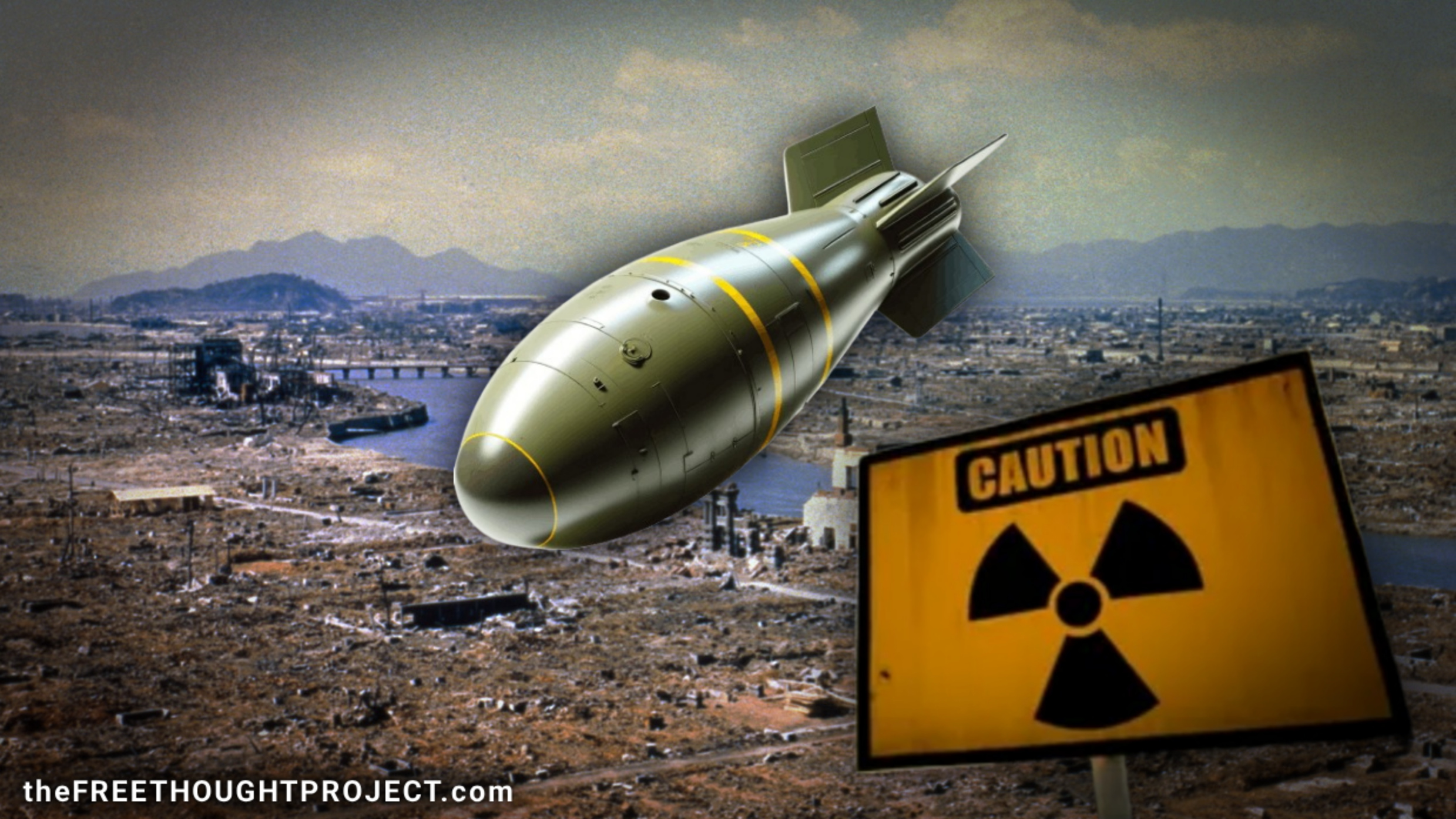


The bombs that destroyed Hiroshima and Nagasaki were primitive by modern standards. Today’s nuclear arsenals are vastly more destructive.
(The Japan Times) At 8:15 a.m. on Aug. 6, 1945, the morning rush had begun in Hiroshima. Streetcars rattled through the city, office workers settled at their desks and children prepared for another day of school. Then, in an instant, a blinding flash brighter than the sun engulfed the city.
A U.S. B-29 bomber, the Enola Gay, had dropped the world’s first atomic bomb used in war. Tens of thousands died within moments as a mushroom cloud climbed into the sky. By the end of 1945, an estimated 140,000 people had died from the blast, burns and radiation.
Among those who witnessed the bombing was Tameto Uemori, a member of a suburban guard unit sent the following day to help victims at the center of the devastation. In his 40s at the time, Uemori witnessed the detonation from miles away, but the next day began searching through the ruins for members of his family. Along the way, he tried desperately to help the wounded. Everywhere he looked were scenes almost beyond imagination: people burned beyond recognition, victims crying out for water and entire neighborhoods reduced to ashes.
Flies and maggots had begun to infest the remains of those who perished, Uemori recalled in a 1987 interview with The Associated Press at the age of 88. He eventually discovered that members of his own family had died in the bombing, including his younger brother. “It was a hot summer day,” he told AP. “So I used a parasol — and the flies came under to escape the sun.”
The memories never left him.
Lifelong campaign
Rather than allowing grief to consume him, Uemori dedicated the rest of his life to ensuring others would never experience what Hiroshima endured. He became one of countless hibakusha — the survivors of the atomic bombings — who transformed unimaginable personal tragedy into a lifelong campaign against nuclear weapons.
In his 1987 interview, Uemori, who has since died, made a plea to the world regarding nuclear disarmament that remains as urgent today as it was then.
“We have to stop it now — now!” he said. “My prayer is that all people are brothers and sisters and we have to cooperate to stop this. We should look to the future and make the most of the lesson of Hiroshima.”
His words were not political rhetoric; they came from someone who had seen the horrors of nuclear devastation and witnessed its human toll.
Another firsthand witness to the destruction reached much the same conclusion from the opposite side of the war. Sandford Z. Persons served in the U.S. Navy during World War II and later returned to Japan as part of the American occupation. When he was stationed in Hiroshima four months after the bombing, he encountered devastation unlike anything he had imagined possible. Entire districts had been erased. Survivors wandered through landscapes that scarcely resembled a city.
The experience haunted Persons for years. He eventually abandoned a successful business career and devoted himself to the cause of peace, becoming director of the World Federalist Movement and advocating for international treaties that would reduce the threat posed by nuclear weapons until his death in 1984.
The significance of Uemori and Persons lies not only in what they witnessed but in what they concluded. One was Japanese, the other was American. They had stood on opposite sides of history’s most destructive war. Yet both believed humanity’s future depended on preventing nuclear weapons from ever being used again.
Their shared conviction deserves renewed attention.
The United States dropped atomic bombs on Hiroshima on Aug. 6, 1945, and Nagasaki three days later. Together, the bombings killed hundreds of thousands of people through blast, fire and radiation. Historians continue to debate whether the attacks were necessary to end World War II or whether Japan could have been compelled to surrender by other means.
Reasonable people may continue to disagree about those historical questions.
What should not be disputed is that the bombings demonstrated the unprecedented destructive power of nuclear weapons and forever altered international politics. Humanity crossed a threshold from which there could be no return.
The bombs that destroyed Hiroshima and Nagasaki were primitive by modern standards. Today’s nuclear arsenals are vastly more destructive.
According to the Arms Control Association, the world’s nuclear powers collectively possess more than 12,000 nuclear warheads. Many are far more powerful than the bomb that destroyed Hiroshima. A single modern thermonuclear weapon could devastate an entire metropolitan region.
Despite decades of arms control agreements, progress toward reducing these arsenals has slowed dramatically. Major powers are modernizing their nuclear forces while geopolitical tensions have risen in Europe, the Middle East and the Indo-Pacific. The danger is not simply intentional war. Miscalculation, accident, cyberattack or escalation from a conventional conflict all carry nuclear risks.
Remembering Hiroshima, therefore, cannot become a once-a-year ritual. It must become a reminder that nuclear weapons remain an urgent contemporary problem.
Irish writer Patrick Comerford captured another overlooked dimension in an article published in 1987. He observed that the money required for a single nuclear missile could instead provide food, clean water and medicine for thousands of children.
His point remains compelling.
Nuclear weapons impose costs even when they are never launched. Governments spend enormous sums maintaining and modernizing arsenals that, by design, can never be used without catastrophic humanitarian consequences. Every dollar devoted to expanding nuclear stockpiles is a dollar unavailable for public health, education, infrastructure or scientific research.
Security matters. Nations have legitimate concerns about deterrence and defense. The world is dangerous and no country can ignore genuine threats.
Yet history also demonstrates that arms control agreements have made the world safer. The Nuclear Non-Proliferation Treaty helped limit the spread of nuclear weapons. Bilateral agreements between Washington and Moscow eliminated thousands of warheads during the Cold War. Verification mechanisms proved that rivals could reduce arsenals while protecting their national security.
That work should not be abandoned simply because it has become politically difficult. The United States, Russia and China possess the world’s largest nuclear arsenals and therefore bear the greatest responsibility for reducing the danger. Serious dialogue among these powers should accompany efforts to resolve conflicts such as the war in Ukraine and other regional crises. Arms control has historically succeeded not because countries trusted one another but because they recognized that mutual vulnerability demanded cooperation.
Step by step
Disarmament need not happen all at once. Step-by-step reductions, transparent verification, renewed treaty negotiations and continued international engagement remain practical goals. Fewer nuclear weapons mean fewer opportunities for catastrophe and fewer resources diverted from urgent human needs.
Citizens also have a role to play. Organizations such as Back from the Brink continue advocating policies that reduce nuclear dangers. Individuals can support educational initiatives, encourage elected officials to pursue arms control agreements and preserve the testimony of the remaining hibakusha, whose numbers diminish each year.
The generation that witnessed Hiroshima firsthand is rapidly disappearing. Soon there will be no living survivors able to describe what they saw on that August day in 1945. What will remain are their words, their warnings and the responsibility they leave to us.
Tameto Uemori did not spend the rest of his life asking the world to remember Hiroshima simply because it was history. He asked us to remember because the history he lived through could be repeated.
The anniversary of the atomic bombing of Hiroshima should therefore be more than a day of remembrance. It should be “Disarmament Day” — a day when governments recommit themselves to reducing nuclear dangers and ordinary citizens recommit themselves to demanding that they do so.
The survivors have already given the world their testimony. Whether we finally act on it is up to us.
